Why LiFePO4 + Solar = 10-Year Battery Life for Servers
Ask any data center operator about their biggest recurring headache, and batteries will be near the top. Traditional UPS batteries — valve-regulated lead-acid (VRLA) — last 3-5 years under daily cycling. For a 10MW facility, that's a $2 million replacement bill every 4 years. Over 20 years, you're looking at $10 million just in battery replacements.
In the DC-direct architecture I described in Part 2, LiFePO4 batteries last 10-15 years. Not because of magic — because of how the system uses them.
The Secret: Batteries as Buffer, Not Primary Source
In a traditional UPS, the battery is the insurance policy. It sits there fully charged, waiting for a grid failure. When the grid fails, the battery dumps its full charge to keep servers running until the diesel generator starts. Then it recharges fully and waits again.
This sounds gentle, but it's actually brutal on batteries. VRLA batteries in standby suffer from sulfation, stratification, and thermal degradation — even when they're not cycling. And when they do cycle, it's often a deep discharge under high current, which accelerates wear.
In the DC-direct architecture, the battery plays a completely different role. It's a buffer — a flywheel that smooths the gap between solar generation and server consumption. Here's how this changes everything:
1. Solar Handles the Heavy Lifting
During daylight hours (roughly 60-80% of total operating time depending on location), the solar array feeds the server load directly. The battery only absorbs surplus solar energy. For most of the day, the battery is barely working — it's receiving a gentle trickle charge from excess solar production.
2. Most Cycles Are Shallow
When the battery does discharge (nighttime, cloudy periods), the discharge is typically shallow — 20-30% DOD (Depth of Discharge). The system is designed with enough battery capacity that a full night of operation only requires a moderate discharge, and the next morning's solar production starts recharging immediately.
3. LiFePO4 Loves Shallow Cycles
This is where chemistry meets system design. LiFePO4 cycle life varies dramatically with DOD:
| Depth of Discharge | Cycle Life | Equivalent Years* |
|---|---|---|
| 100% DOD | 2,000 cycles | ~5.5 years |
| 80% DOD | 4,000 cycles | ~11 years |
| 50% DOD | 6,000 cycles | ~16 years |
| 30% DOD | 10,000+ cycles | ~27+ years |
*Assuming one cycle per day
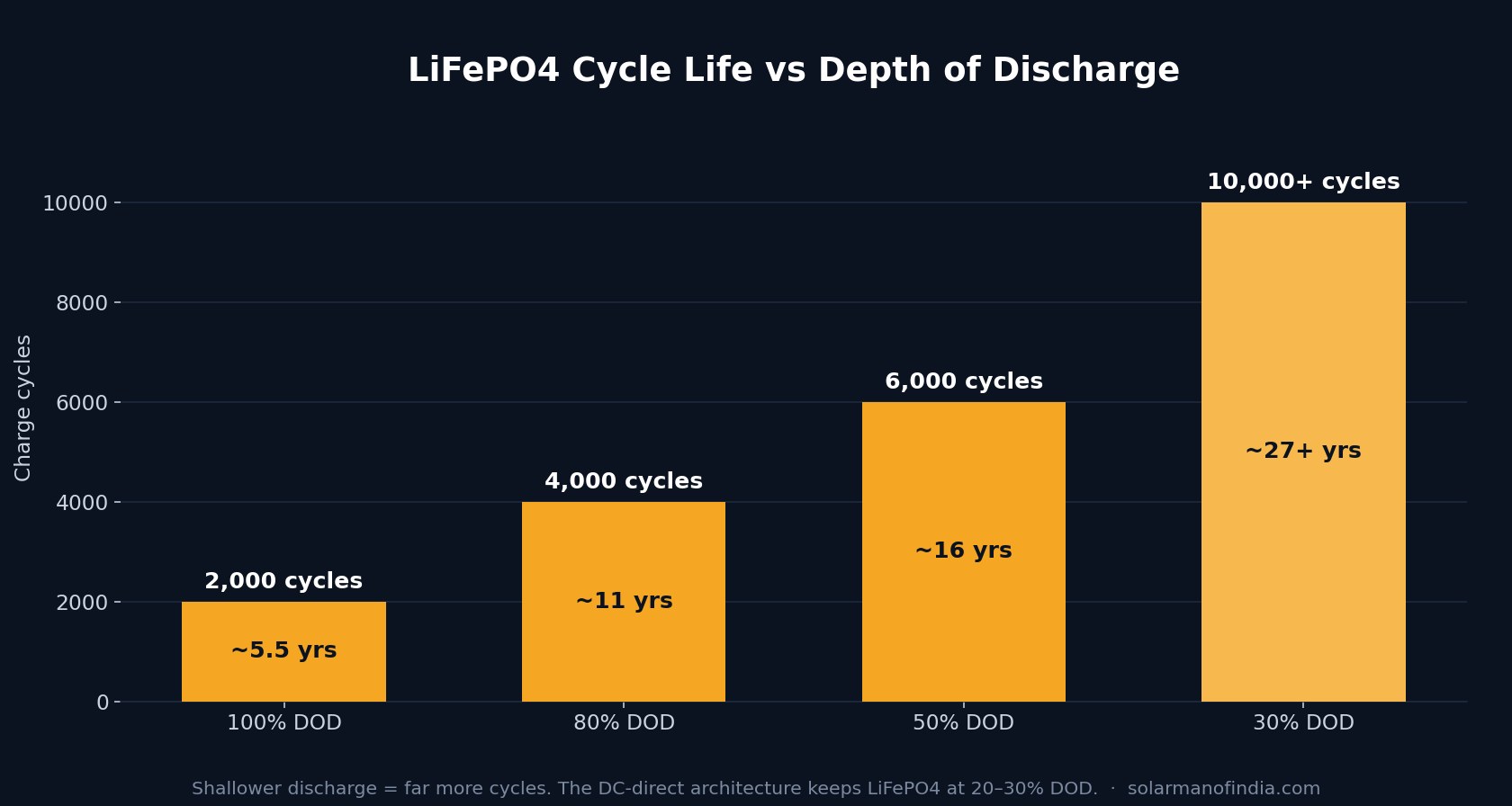
At the 20-30% DOD typical in the DC-direct architecture, LiFePO4 batteries can deliver 10,000+ cycles. Even with one cycle per day, that's 27+ years of theoretical life. In practice, accounting for calendar aging and environmental factors, 10-15 years is a conservative real-world expectation.
4. The MPPT Controller Manages Battery Health
This is where Patent #72 (Hybrid Solar Charge Controller) and Patent #76 (Power Flow Management) come into play. The intelligent MPPT controller doesn't just charge and discharge blindly. It limits maximum DOD to 70%, controls charge/discharge rates to avoid high-current stress, monitors cell temperatures, initiates periodic conditioning cycles, and triggers AC failover before deep discharge — when SOC drops to 30%, AC backup activates.
5. Less Heat = Longer Life
In the traditional architecture, 21% of power converts to waste heat. That heat raises the ambient temperature in the battery room. Every 10°C rise above 25°C cuts VRLA battery life roughly in half. In the DC-direct architecture, conversion losses drop to 5%. Less heat means lower ambient temperatures. The battery operates closer to its ideal temperature range, adding years to its life.
The Cost Comparison Over 20 Years
| Parameter | Traditional UPS (VRLA) | DC-Direct (LiFePO4) |
|---|---|---|
| Battery replacement cycle | Every 3-5 years | Every 10-15 years |
| Cost per replacement (10MW) | ~$2M | ~$3M |
| Replacements over 20 years | 4-5 times | 1-2 times |
| Total 20-year battery cost | ~$8-10M | ~$3-6M |
| Weight | 100% (baseline) | ~30% of VRLA |
| Footprint | 100% (baseline) | ~40% of VRLA |
Why Not Lead-Acid in the DC-Direct System?
You could theoretically use lead-acid batteries in a DC-direct architecture. But the economics collapse. Lead-acid doesn't handle daily cycling well. Charge efficiency is lower (80-85% vs 95-98% for LiFePO4). The weight and footprint penalty is 3x. Maintenance requirements add operational cost. LiFePO4 is purpose-built for the daily charge-discharge rhythm of a solar-powered system.
Real-World Validation
At Su-Kam, we deployed the DC 120 Solar Home System with lead-acid batteries initially, then moved to lithium. The lithium units showed dramatically better field performance — not just longer life, but more consistent capacity over time. A lead-acid unit that started at 100Ah would be down to 60Ah after 2 years of daily cycling. The LiFePO4 units maintained 95%+ capacity after the same period.
The Bottom Line on Batteries
The DC-direct architecture doesn't just save power — it fundamentally changes the economics of energy storage in data centers. By using batteries as buffers rather than emergency reserves, by keeping discharge cycles shallow, and by pairing LiFePO4 chemistry with intelligent MPPT management, the system achieves 3x longer battery life, 50% lower 20-year battery cost, 70% less weight, and dramatically lower environmental impact.
In Part 4, I'll show how adding an AI monitoring layer can push efficiency even further — with predictive solar forecasting, load prediction, and battery health AI.