Engineering for Government Scale: The TEDA 100Wp Solar PCU
How we evolved from basic solar lamps to an MPPT-driven, TUV-certified Power Conditioning Unit for Tamil Nadu's state solar program.
2011–2013 · Su-Kam Power Systems Limited
When the Tamil Nadu Energy Development Agency (TEDA) issued requirements for a solar home lighting system, they weren't asking for a lamp. They were asking for a power infrastructure — one that could be monitored, measured, and held accountable across thousands of government-deployed installations. Meeting those requirements forced us to rethink everything we knew about solar home systems. The result was a 100Wp Power Conditioning Unit that represented a generational leap from where we started.
From Lamps to Infrastructure
Our first product, the HLS1210, was a compact solar home light — two LED lamps, a series regulator, and a 12V battery. It worked well for what it was. But government-scale deployment demanded capabilities the HLS1210 was never designed to provide: energy metering on both input and output sides, onboard data logging, grid-solar hybrid operation, IEC-certified performance, and the ability to run standard AC loads like CFL bulbs.
The TEDA 100Wp PCU addressed every one of these requirements while introducing innovations we'd file patents for.
System Architecture
100VA PCU — Functional Block Diagram
Solar PV Array
Charge Controller
(DC-DC)
Battery Bank
Supply
Grid Charger
+ RTC Control
5×9W CFL
100VA
The architecture was fundamentally different from the HLS1210. Instead of a simple DC system with LED lamps, this was a full AC power conditioning unit with a true sine wave inverter, MPPT-based solar charge controller, grid-tie capability, and intelligent scheduling via an onboard real-time clock.
Key Engineering Advances
MPPT Charge Controller
Microcontroller-based maximum power point tracking for accurate PV module optimization. Patent filed for the integrated approach.
True Sine Wave Output
Clean AC output for running standard loads without degradation. Peak inverter efficiency of 89% (TUV certified).
Dual Energy Metering
True energy meters on both input (grid) and output (inverter) measuring V, I, VA, and kWh. Solar array monitoring for V, I, and kWh generation.
Onboard Data Logging
One-week data retention with RS-232 retrieval. Field engineers could diagnose issues without guesswork.
Galvanic Isolation
Electrical isolation between input and output for improved reliability and safety in field deployments.
Current-Sharing Hybrid
Intelligent grid-solar current sharing. Grid charging supplements solar, never replaces it. Power factor 0.85 with >85% efficiency.
Intelligent Load & Charging Schedule
The onboard RTC managed the system's daily operation automatically, ensuring solar energy was always prioritized:
Inverter ON
Inv. ON
Solar Only
Grid+Solar
Inverter ON
Grid charging was restricted to 10 AM–6 PM and operated in current-sharing mode. If solar PV current exceeded 1.5A, grid charging would reduce proportionally. Maximum combined charging current: 4A.
At night, if the battery dropped to low voltage, the system would bypass mains supply directly to the load without charging the battery — an intelligent decision that prioritized immediate lighting while preventing inefficient low-voltage charging cycles.
Certifications & Compliance
Government deployment required a level of certification the HLS1210 never needed. The TEDA PCU was tested and certified under IEC standards as per MNRE (Ministry of New and Renewable Energy) guidelines. TUV reports validated the claimed efficiency figures: 89% peak inverter efficiency and >85% grid charger efficiency at nominal input voltage.
All IEC test reports were prepared as per MNRE guidelines — the standard required for government solar deployment programs across India.
The Leap in Numbers
| Parameter | HLS1210 (Gen 1) | TEDA 100Wp PCU |
|---|---|---|
| Solar capacity | 3–10W | 100Wp |
| Charge controller | Series regulator | MPPT (patent filed) |
| Battery | 12V / 9Ah | 24V bank |
| Max charge current | 600mA | 4A combined |
| Output | DC LED lamps | True sine wave AC, 100VA |
| Inverter efficiency | N/A | 89% peak (TUV) |
| Grid integration | None | Current-sharing hybrid |
| Monitoring | 2 LEDs | LCD + dual energy meters |
| Data logging | None | 1 week + RS-232 |
| Load | 2 LED lamps | 5 × 9W CFL / 100VA |
| Certifications | — | IEC / TUV / MNRE |
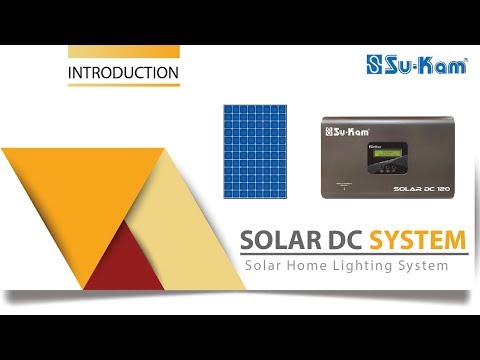
Su-Kam Solar DC System 120 — Watch It in Action
Videos from the official Su-Kam YouTube channel showcasing the 12V 120W Solar DC System.

The TEDA 100Wp PCU proved that solar home lighting could meet government-grade standards for metering, efficiency, and reliability. From a 3W lamp to a TUV-certified power conditioning unit — this is what continuous engineering looks like.