Engineering Solar Monitoring Without Internet
The Handheld Device That Powered India's Solar Data Revolution
When TEDA commissioned Su-Kam to build solar PCUs for rural Tamil Nadu in 2007, they didn't just want power. They wanted proof. Actual kilowatt-hour data from every installed unit. The problem: rural Tamil Nadu had no internet, no cellular data, no cloud infrastructure.
Su-Kam's R&D team had to solve two problems simultaneously: build a solar PCU that could log its own performance data, and build a way to get that data out.
114 Bytes That Told the Whole Story
Su-Kam engineer Prashant Sharma led the design of the communication protocol — a serial interface specification documented in a formal technical manual. The protocol was elegant in its thoroughness.
Every time the PCU was queried, it transmitted exactly 114 bytes of data. Those 114 bytes contained over 26 distinct parameters — a complete snapshot of the solar system's health:
The 114-Byte Data Packet Included:
For a 600VA, 24V solar PCU designed for rural Indian households, this level of telemetry was extraordinary. Most inverter manufacturers offered a blinking LED to indicate "working." Su-Kam's PCU was a full data acquisition system disguised as a power conditioning unit.
The Handheld Device — Built Because Nothing Else Existed
The PCU could log data. But how do you read that data from a device installed on a rooftop in a village with no internet?
Su-Kam's answer was to build its own hardware. Engineer Kamal Kant Sandeep led the design of a custom Hand-Held Device — a purpose-built instrument designed specifically for the TEDA project.
The device was powered by a 9V Duracell battery. It had a keypad with four function keys (F1-F4), an LCD screen, and an RS232 serial port. The workflow was methodical: power on, enter site number, enter circle number, enter PCU serial number, press F3 to read. A field technician could visit multiple PCU sites in a single trip.
The serial numbering system was itself an engineering decision. Each PCU was identified by a five-digit code: XX'YYY — site, circle, and individual PCU number. This hierarchical addressing meant data could be organized geographically when downloaded.
From Field to Report
Back at the office, the handheld connected to a PC via USB cable. Su-Kam built custom utility software — the "Handheld Device Reader" — that ran on Windows XP.
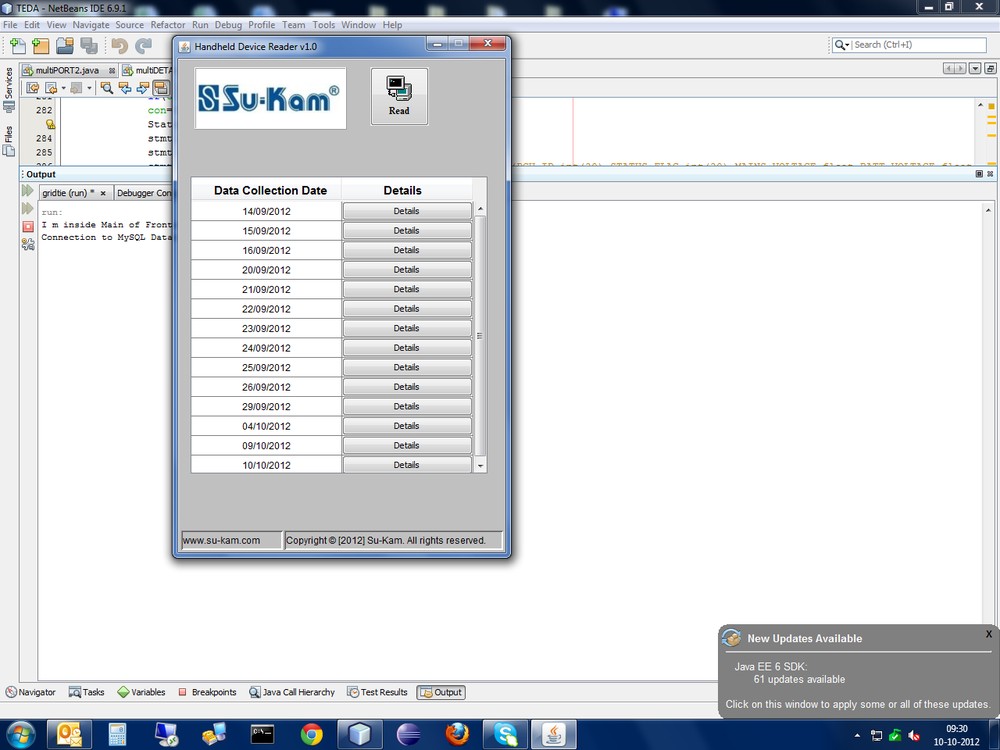
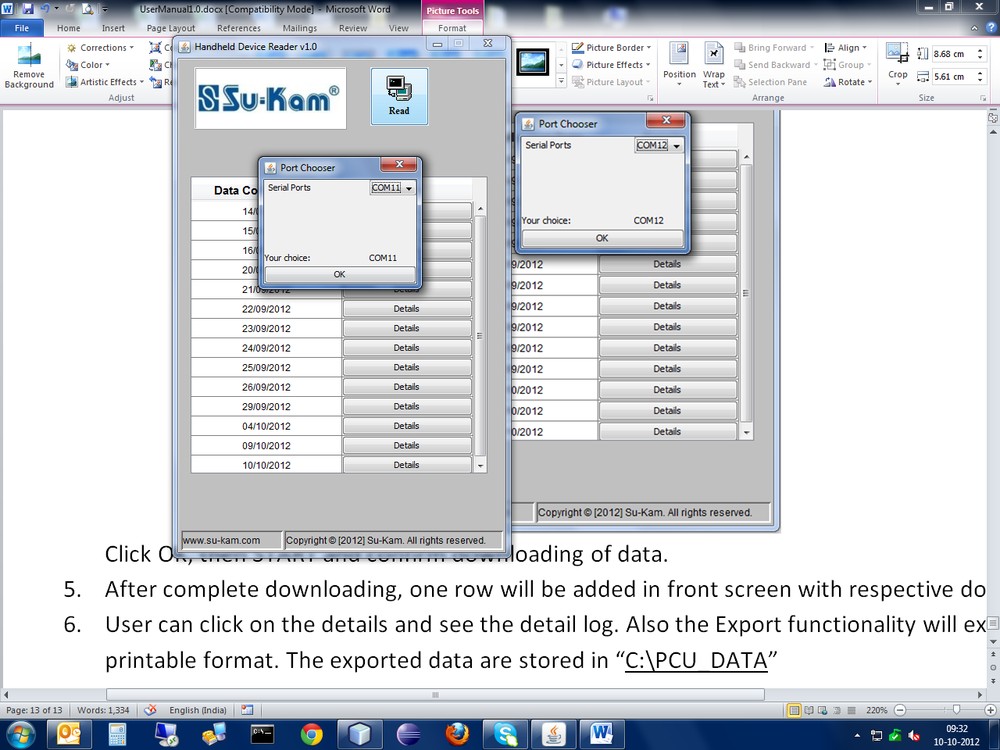
The complete data pipeline — PCU firmware → handheld device via serial cable in the field → USB to PC → printable reports — was an end-to-end monitoring system built entirely by Su-Kam's R&D team. No third-party components. Every piece designed in-house.
From Government Project to Commercial Product
By 2010-2011, Su-Kam transformed the TEDA monitoring technology into the commercial-grade Solar PCU Monitoring Software Version 2.0.
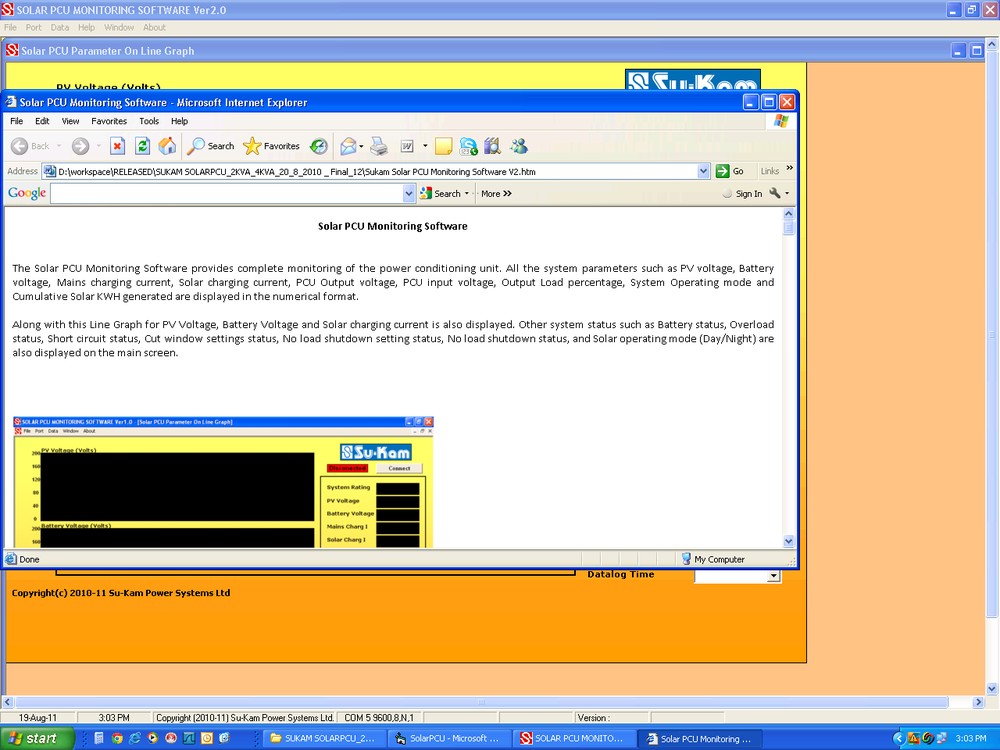
Monitoring Software V2.0 Features:
Real-time dashboard — all PCU parameters updated every second
Live line graphs — PV voltage, battery voltage, solar current scrolling charts
Database logging — every reading automatically stored with full history
CSV export — one-click data transfer for reports and government submissions
On-board datalog — access PCU's own non-volatile memory remotely
RTC sync — PC clock programmed into PCU for precise timestamps
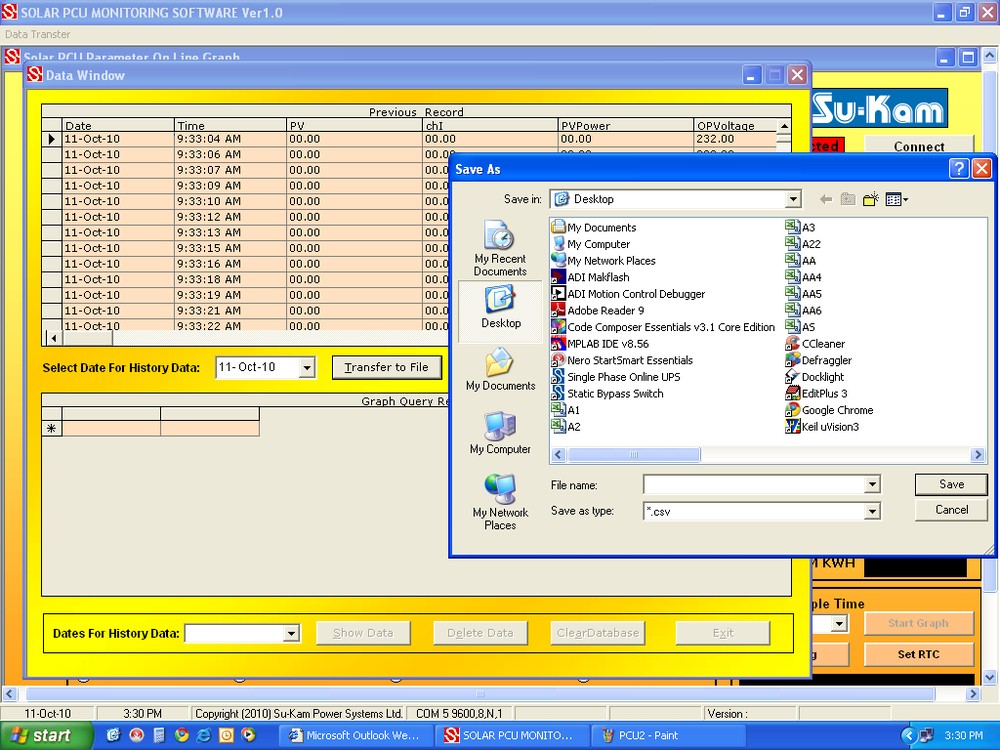
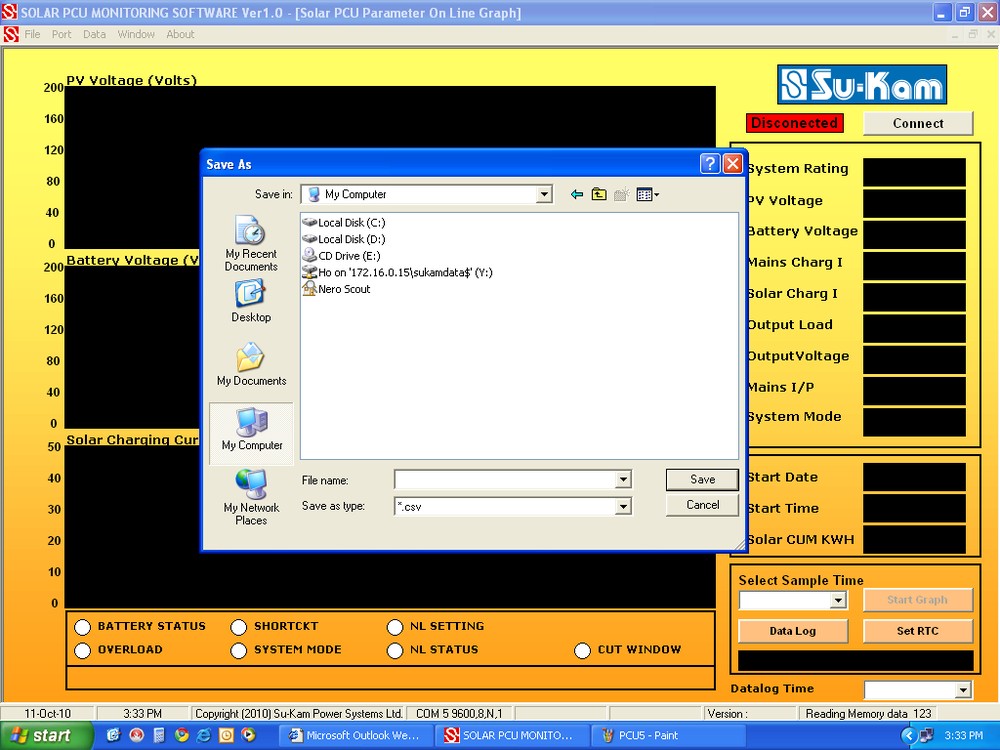
Remember: this was 2010-2011. No Bluetooth. No Wi-Fi module in an inverter. No smartphone app. No cloud dashboard. The entire Indian solar industry was selling boxes with no visibility into whether they were working properly.
Why This Matters
Today, solar monitoring is trivial. Every rooftop inverter ships with Wi-Fi and a smartphone app. Companies like Enphase and SolarEdge built billion-dollar businesses around monitoring platforms.
But in 2007-2011, none of that existed — especially not in India. Su-Kam didn't wait for Bluetooth or Wi-Fi. It didn't wait for cloud computing. It built the monitoring infrastructure itself, with the technology available: serial protocols, handheld devices, RS232 cables, and Windows desktop software.
Three primary engineering documents survive from this era — and they document what may be the earliest complete solar telemetry ecosystem engineered by an Indian company.
Competitors sold solar panels. Su-Kam engineered solar intelligence. And it did so before the word "IoT" existed in India's vocabulary. What Su-Kam built with RS232 cables and Duracell-powered handhelds, the industry would later replicate with Wi-Fi modules and cloud APIs. But Su-Kam did it first.
Solar PCU Series
Read Part 1: The TEDA Origin Story | Part 3: The PCU Goes Global
References & Sources
- Kunwer Sachdev — Wikipedia
- Su-Kam Power Systems — Wikipedia
- Hand-Held Device User Manual — Su-Kam R&D
- TEDA 600VA 24V Communication Protocol — Su-Kam R&D
- Solar PCU Monitoring Software V2.0 — Su-Kam R&D
- Sudeep Jain, IAS — Windergy India
- Tamil Nadu Energy Development Agency — Wikipedia
- How Kunwer Sachdev Sparked a Solar Revolution — InverterIndia
- Solar Man of India: The Innovator — KunwerSachdev.com