We Sold Power to HUDA Metro. Dust and Theft Were the Real Teachers.
RESCO at HUDA City Centre — we put a hundred kilowatts over the parking and leased the power to DMRC. Dust ate the yield. Theft stretched the install. That is the story I want on record.
By Kunwer Sachdev · CEO & Managing Director, Su-Kam (at the time) · Founder 1988–2018 · Published September 28, 2026 · Historical era: commissioned Sep 2015 · NCN 25 Sep 2015
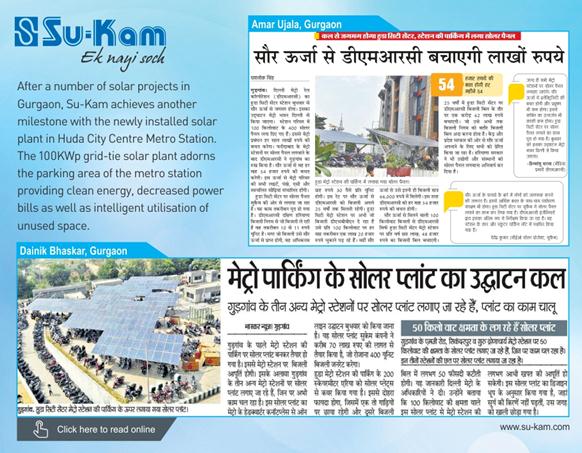
External — NCN Online (25 Sep 2015): 100 kWp in HUDA City Centre parking; RESCO — Su-Kam builds free of capital cost to DMRC, sells power at ~₹6/unit for 25 years, maintains the plant; ~1.4 lakh units/yr; also installing 50 kWp each at MG Road, Sikanderpur, Guru Dronacharya. Metro Rail Guy (28 Sep 2015) credits Su-Kam photos and the parking canopy. No Facebook-archive card found — press-first.
RESCO Only — We Leased the Power to DMRC
Under my leadership as CEO & MD, Su-Kam did not sell a plant to Delhi Metro and walk away. We did RESCO. Press is explicit: NCN wrote that Su-Kam set up the 100 kWp grid-tie system at HUDA City Centre metro parking entirely free of cost to DMRC, then sold the electricity to DMRC at about ₹6 per unit for twenty-five years, with Su-Kam on maintenance. That is install and lease the power — our capital, our O&M, their units at a fixed tariff.
DMRC’s wider solar programme used the same idea: developer owns the asset; metro pays only for energy. ETEnergyworld later summarised that RESCO logic for Delhi Metro. HUDA City Centre was our flagship Gurugram proof of it — and the hardest classroom.
Ground-Mounted Over a Living Parking Lot
This was not a quiet rooftop. It was a ground-mounted canopy over a working metro parking area — bikes, cars, people, every hour of the day. Metro Rail Guy called it a ground-mounted install at the car shed / bike port, roughly 1,250 sq. metres, about 400 panels, commissioned around 23 September 2015, framed to feed escalators and station load. Our Hindi press composite shows the same picture: panels as a roof over a sea of two-wheelers. Unused space became generation. It also became a dust bowl.
Dust — The Yield We Never Fully Got
Here is the founder line the press release will not print. Dust was everywhere — from the lot, the road, the city. Cleaning and keeping output up was always a big challenge. In planning we did not take that into care the way a parking canopy demands. So the plant never gave the desired 100% output we had modelled. Units were real; the nameplate dream was not. Brochure solar assumes a clean plane. Metro parking solar assumes grit on every module, every week. If you under-plan O&M for dust, RESCO maths quietly leaks.
Theft During Install — Time We Did Not Budget
NCN celebrated another difficulty: working in a functional parking area without harming people or vehicles, and pulling cable from the lot to the LT room — then said the team finished in about fifteen days. That careful site work was real. What I add as CEO & MD is this: during installation there was theft of solar panels. Replacing what was stolen and securing the job meant the system took more time to install than the neat headline suggests. Open metro parking is not a locked factory yard. Panels are valuable. We learned that the expensive way.
The Other Gurugram Stations
Same RESCO model, same era: NCN and the Dainik Bhaskar clip on our flyer say Su-Kam was putting 50 kWp-class plants at MG Road, Sikanderpur and Guru Dronacharya — work underway in that September 2015 window. HUDA was the 100 kWp flagship. The smaller stations were the roll-out. Under my watch the idea was one programme: Su-Kam capital, Su-Kam maintenance, DMRC buying units — solar as a service across Gurugram’s yellow-line corridor.
On the same Gurgaon map we already had institutional roofs — SBI Academy, EIL, IFFCO. HUDA was different: not a prestige HQ elevation, but a public parking canopy where every motorcycle kicked dust at our yield.
What I Want on Record
Kunwer Sachdev — CEO & MD of Su-Kam. HUDA City Centre metro, Gurugram: 100 kWp grid-tie over the parking (Sep 2015) under RESCO only — Su-Kam funded and maintained; power sold to DMRC (~₹6/unit, 25 years). Founder lessons: dust meant the plant never hit desired 100% modelled output; panel theft during installation made the job take longer. Press: NCN + Metro Rail Guy + Su-Kam Amar Ujala / Dainik Bhaskar composite. No FB archive card — press-first.
Verified Sources
- NCN Online (25 Sep 2015) — Su-Kam 100 kWp HUDA City Centre; RESCO; sell to DMRC @ ₹6/unit / 25 yrs; three more Gurugram stations
- The Metro Rail Guy (28 Sep 2015) — HUDA City Centre 100 kWp parking plant; Su-Kam photos; ~1.4 lakh units/yr
- ETEnergyworld — DMRC solar overview (RESCO = developer owns plant; DMRC pays only for energy)
- Companion — SBI Academy Gurugram 100 kWp
- Companion — EIL Gurugram 90 kWp
- Companion — IFFCO Gurugram HQ
- Companion — NHPC Faridabad 70 kWp
Related
- SBI Academy Gurugram — 100 kWp
- EIL Gurugram — Navratna consultant roof
- IFFCO Gurugram HO — aesthetics first
- NHPC Faridabad — 70 kWp
- Facebook Archive (no native HUDA card — see press-first card when wired)
FAQ
What model was the HUDA City Centre solar plant?
RESCO only. NCN Online (25 Sep 2015) states Su-Kam set up the 100 kWp plant entirely free of capital cost to DMRC and sold the electricity to DMRC at about ₹6 per unit for 25 years, with Su-Kam providing maintenance. That is install-and-lease-the-power — not an EPC sale of the plant to the metro.
Where was it installed?
Ground-level parking at HUDA City Centre metro station, Gurugram — an elevated canopy / superstructure over the bike and car park (not the station building roof). Metro Rail Guy and Su-Kam’s own press composite (Amar Ujala / Dainik Bhaskar) show panels over a packed two-wheeler lot.
What capacity and output did press claim?
100 kWp; over ~1.4 lakh units/year (NCN / Metro Rail Guy); Hindi press on the Su-Kam flyer also frames ~400 units/day. DMRC’s solar booklet lists Su-Kam as developer, ~400 × 250 Wp modules, Delta inverters, and a tariff around ₹5.845/unit for 25 years.
What does Kunwer Sachdev say went wrong?
Founder account: dust across the open parking site was not planned for seriously enough, so cleaning and O&M were a constant fight and the plant never delivered the desired 100% modelled output. Separately, solar panels were stolen during installation, which made the job take longer than it should have. Press celebrated a careful ~15-day site push in a live parking lot; the theft delay is founder memory, not in those articles.
Were other Gurugram metro stations included?
NCN and the Dainik Bhaskar clip on Su-Kam’s flyer say Su-Kam was also installing 50 kWp-class RESCO plants at MG Road, Sikanderpur and Guru Dronacharya. Mid-2015 wording is ‘installing’ / work underway. Founder framing: same RESCO programme across those Gurugram stations under his watch as CEO & MD.
Is there a Facebook archive post?
No HUDA / DMRC metro card was found in this site’s Facebook archive JSON or curated extras. The record here is press-first: NCN, Metro Rail Guy, Su-Kam Hindi press composite, plus founder account.
Historical Documentation Notice:
This article documents historical innovations and installations executed under the leadership of Kunwer Sachdev during his tenure as Founder & Managing Director of Su-Kam Power Systems Ltd. (1988–2018). Kunwer Sachdev exited the company in 2019 under the IBC process and holds no association, affiliation, or liability with Su-Kam Power Systems Ltd. or its subsequent management. Dust-yield and panel-theft details are founder recollection; contemporaneous trade press did not report the theft.