A Petrol Pump That Cannot Afford Darkness: Su-Kam’s 10 kVA Off-Grid System in Jalgaon
Three dispensers. A 10 kVA off-grid Solar PCU. A forecourt that could not wait for the grid.
By Kunwer Sachdev · Founder & Managing Director, 1988–2018 · Published 11 September 2026 · Historical era: 2009–2017

Recovered company record: Su-Kam Blog Archive — Jalgaon 10 kVA petrol pump (original on blog.su-kam.com, Wayback, 8 January 2017).
1. Archive Anchor
- Recovered post: 10KVA Off-Grid Solar System Runs 3 Fuel Dispensers in Jalgaon Petrol Pump
- Site named in that record: SSPS Sethi Sons HP petrol pump, owned by Mr. Sethi, Jalgaon district, Maharashtra.
- Earlier company line: Petrol Pumps Powered by Su-Kam — September 2009, recovered from blog.su-kam.com.
- Facebook: nationwide solarisation campaign (July 2014) and Andhra Pradesh press on the first solar-backed pumps (April 2013).
- My role: I was Founder, MD and CEO of Su-Kam. The Solar PCU line, the petrol-pump programme, and the company blog were built under that tenure. This page does not claim I commissioned the Jalgaon pump in person.
2. Why a petrol pump was a solar problem
By Kunwer Sachdev (Founder & Managing Director, 1988–2018)
A house can wait out a power cut. A petrol pump cannot. When the dispensers stop, the queue leaves. Diesel generators were the default answer — noisy, expensive, and another fuel bill on a site that already sold fuel.
The starting current problem
The first petrol pumps were a real engineering challenge. A fuel dispenser is not a fan or a tube light. When the motor kicks, the starting current — the jerk current — is very high. An inverter sized for the running watts will trip, or the voltage will sag, and the nozzle stops. That is why a generator looked easier: it could swallow the surge.
Worse, every pump was different. Different makes, different motors, different starting current. There was no one surge number you could print on a brochure and send to every forecourt. We had to size and tune the Solar PCU so it would take that jerk without collapsing the rest of the load — the other dispensers, the office, the lights — and still prefer solar over diesel.

For a bigger forecourt the cabinet scaled up: Colossal 3P, 80 kVA / 360 V. Grid in; thirty 150 Ah / 12 V batteries in series (1.8 kWh each, 360 V string); the PCU runs the petrol-pump load and charges the bank at the same time. That is how we kept three-phase dispensers from collapsing when one motor jerked.
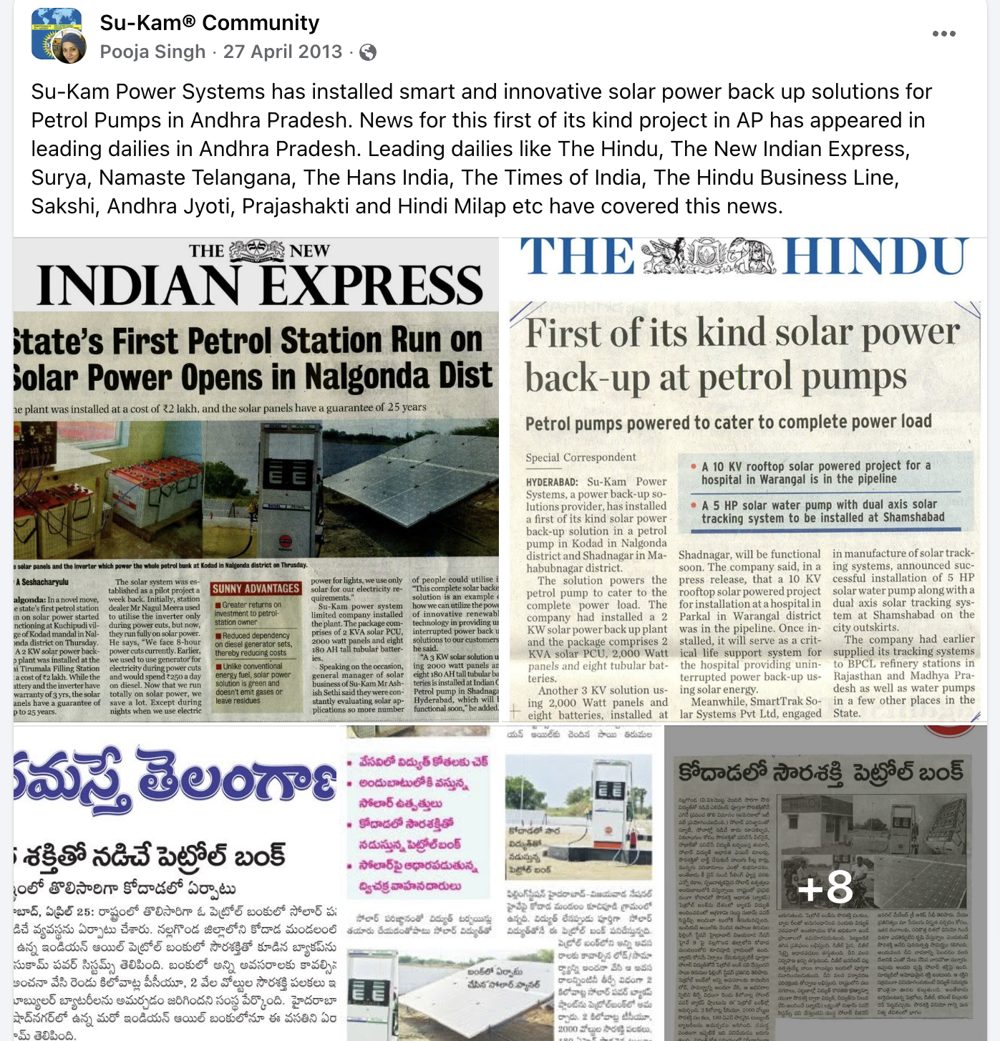
We were the first company to solarize petrol pumps in various parts of India. Then every company copied the technology and started selling. The 2013 Nalgonda cuttings, the 2015 Panipat dailies, this Jalgaon 10 kVA — that was the line. The jerk-current PCU was not a brochure feature others had lying around. They followed.

That is why Su-Kam was already on petrol-pump backup in 2009: dispensers, POS and lighting on inverters and batteries. The recovered September 2009 post is the start of that commercial line — years before Jalgaon. By April 2013 the Andhra Pradesh dailies were writing about solar-backed pumps in the state, including a Nalgonda station billed as the state’s first. By July 2014 the company Facebook page was calling it an initiative: Indian Oil and other forecourts on Su-Kam PCUs, inverters and panels, cutting the generator out of the daytime load.
Jalgaon, in the recovered January 2017 company blog, is one named site in that line: a 10 kVA off-grid solar system on an HP pump, carrying three fuel dispensers, the office and lighting. The product on that post is Su-Kam’s DSP sine-wave Solar PCU — solar-priority charging, grid only as fallback. The same class of box went into banks, ATMs, hospitals and malls. I had built that architecture so a commercial load did not have to choose between the grid and a generator.

The same flyer lists other 10 kVA and 6 kVA jobs we had already done: Indian Oil Sonepat (10 kVA online UPS, 16 Bazooka batteries, 3,840 W of 80 W panels); two 6 kVA Solar PCUs at Hindustan Petroleum, Chandragiri, Tirupati; Indian Oil at Chahal, Punjab; APG Oil, Saha, Ambala and Shivalik Oil, Kala Amb (10 kVA with 180 V / 50 A charge controllers); Indian Oil at Morwala, Bhiwani (10 kVA, 120 V / 60 A). Panipat’s Royal Indian Filling Station is the Haryana first that the dailies wrote in June 2015 — Dainik Tribune, 3 June 2015. Andhra Pradesh had already been in print in 2013 — Kodad and Shadnagar.
3. What the 10 kVA box was doing
Off-grid here does not mean “no grid ever.” It means the pump’s critical load — the three dispensers and the shop — could run from panels and a battery bank when the Maharashtra grid dropped. Solar-priority is the same idea we used in homes: use the sun first, spare the battery, touch the grid last. The walkthrough of how that PCU family switched day and night, and showed solar kWh on the LCD, is in Su-Kam’s 6.25 kVA / 96 V off-grid Solar PCU. The Jalgaon record is the 10 kVA commercial cousin, not a second copy of that demo video.
Related Su-Kam training film — 10 kW off-grid rooftop. Not a Jalgaon site video.
4. Ground record
| Parameter | From the recovered record |
|---|---|
| Named site | SSPS Sethi Sons HP petrol pump, Jalgaon district, Maharashtra |
| Owner named in archive | Mr. Sethi |
| System | 10 kVA off-grid solar, DSP sine-wave Solar PCU |
| Load | Three fuel dispensers, office equipment, lighting |
| Engineering challenge | High starting / jerk current on each dispenser; inrush different from pump to pump |
| Company blog | blog.su-kam.com — Wayback snapshot 8 January 2017 |
| Earlier petrol-pump line | 2009 inverter backup; 2013 AP solar-pump press; 2014 Facebook solarisation campaign |
5. Hub — media and sister stories
- Hub — petrol-pump inverter + patent 1255 sales monitoring
- Episode 4 — AP 2013 Kodad / Shadnagar press
- Episode 6 — Panipat / Sanoli, June 2015
- Recovered Jalgaon archive page
- 2009 — Petrol Pumps Powered by Su-Kam
- Facebook Archive — petrol-pump solarisation and AP press cards
- 6.25 kVA / 96 V off-grid Solar PCU walkthrough
- Episode 2 — Assam Rifles 18 sites / 1.3 MW
- Episode 3 — Tamil Nadu Green House
- Episode 1 — 40,000 Direct-DC homes
- Su-Kam Solar YouTube (@sukam)
Historical Documentation Notice:
This article documents historical products and installations executed under the leadership of Kunwer Sachdev during his tenure as Founder & Managing Director of Su-Kam Power Systems Ltd. (1988–2018). Kunwer Sachdev exited the company in 2019 under the IBC process and holds no association, affiliation, or liability with Su-Kam Power Systems Ltd. or its subsequent management.
References & Sources
- Recovered Su-Kam archive — Jalgaon 10 kVA petrol pump
- Wayback — original blog.su-kam.com post (8 January 2017)
- Recovered archive — Petrol Pumps Powered by Su-Kam (September 2009)
- Facebook Archive — petrol-pump solarisation initiative (July 2014)
- 2013 Andhra Pradesh solar petrol pumps — The Hindu and Indian Express cuttings
- Su-Kam 6.25 kVA / 96 V off-grid Solar PCU — how the platform worked
- Solar blogs — solarmanofindia.com