We Met Our Malawi Distributor at GITEX. He Built the Su-Kam Brand There.
Exhibition handshake in Dubai. Aggressive execution in Malawi. Villages that had never seen a watt.
By Kunwer Sachdev · Founder & Managing Director, 1988–2018 · Published September 24, 2026 · Historical era: ~2007–2014 (GITEX → Natsons → hybrids)
Primary public cite: Face of Malawi — From darkness to light (3 May 2011). Founder engineering essay: KunwerSachdev.com — Malawi section. Distributor directory listing: Natsons / Su-Kam Solar Malawi.
Brands do not walk into Africa by themselves. Someone has to pick them up at a fair — and then refuse to let go.
GITEX Was Our Favourite Exhibition
For Su-Kam, GITEX in Dubai was not tourism. It was the room where Middle East and African partners walked the aisle looking for power backup and solar that could survive heat, distance and weak grids.
That is where we met the man who would carry Su-Kam into Malawi: Mohammad Nathani. His firm was Natsons.
An exhibition introduction is cheap. What followed was not. Through Natsons he worked the market aggressively — dealers, sites, follow-ups — and turned Su-Kam from a name on a Dubai badge into a brand people asked for in Blantyre and beyond. Local directories still list the house as Natsons / Su-Kam Solar Malawi. That dual name is the point: the brand stuck because his firm pushed it.
Lots of Projects — Brand Built on Ground
Malawi was never a one-poster market for us. Through Natsons we created a run of projects — homes, institutions, remote sites — the kind of volume that only appears when a distributor treats your catalogue as his own reputation.
I give that credit plainly: Su-Kam became a brand in Malawi because of Mohammad Nathani and Natsons. Factory engineering in India matters. Street-level aggression in the destination country matters more for whether anyone ever sees the product.
The Flagship: Wind and Sun in the Same Battery
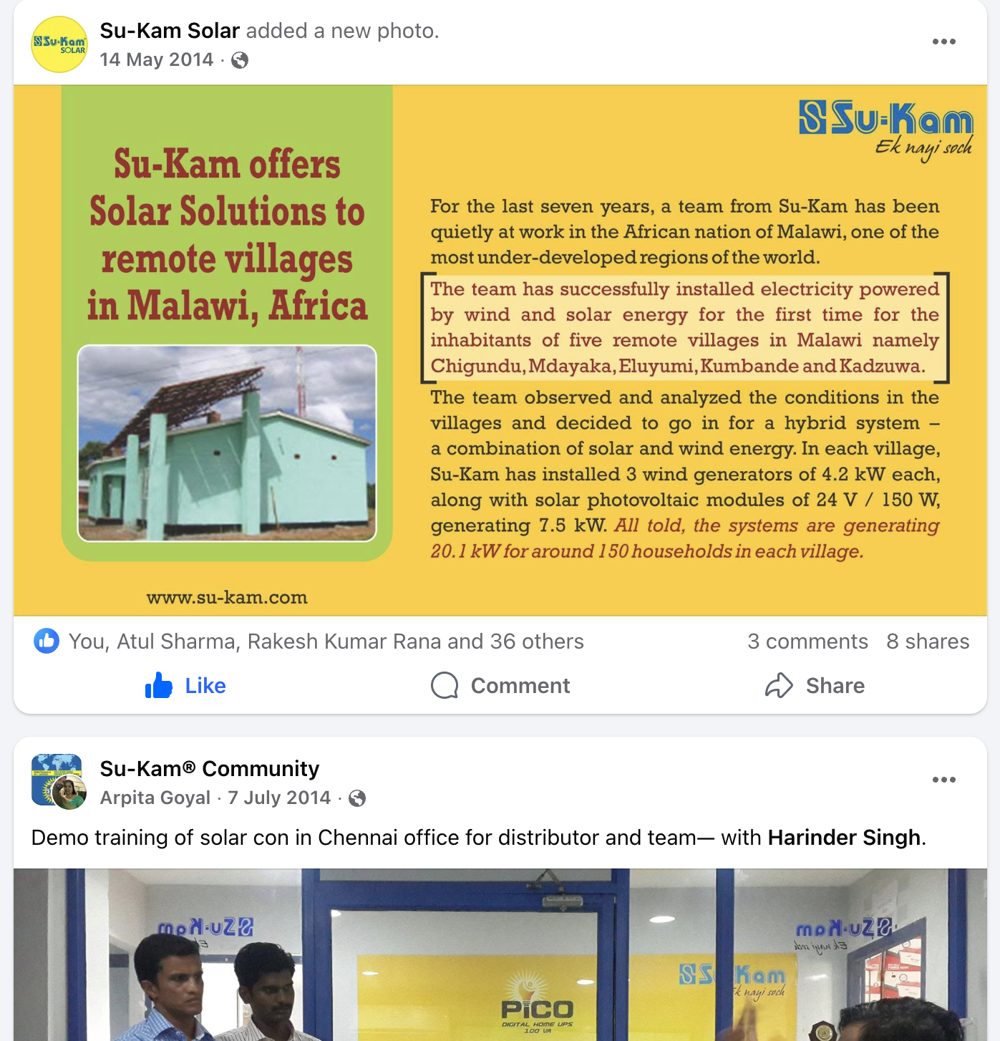
The project the papers and our Facebook archive kept returning to was the hybrid village work. Five remote villages — Chigundu, Mdayaka, Eluyumi, Kumbande and Kadzuwa — seeing electricity for the first time.
Per village, as we published it: three 4.2 kW wind generators plus 7.5 kW of solar PV (24 V / 150 W modules), about 20.1 kW total for roughly 150 households. Wind around 5 m/s on site; sunshine in abundance. In-house R&D customised the hybrid so wind and solar fed a common battery path — not two separate toys fighting each other.
Face of Malawi (3 May 2011) told that story while the systems were live. Our May 2014 Facebook post repeated the same village names and numbers for the archive. On my projects essay I wrote the engineering pride differently: windmills from a Pune supplier, electronics and system design ours, one common output — and I visited personally. I was proud enough of the idea that I replicated wind-plus-solar at my own farmhouse.
What I Want on Record
GITEX introduced us. Mohammad Nathani — through his firm Natsons — executed. Malawi got projects and a Su-Kam brand that people could find. The hybrid villages are the proof that still prints with dates and kilowatts.
Export was never only a brochure map with pins. It was a favourite Dubai fair — and a distributor who refused to be soft.
Verified Sources
- Face of Malawi (3 May 2011) — From darkness to light in Malawi
- KunwerSachdev.com — Solar projects: Malawi wind and sun in the same battery
- Facebook Archive — Wind-Solar Hybrid Power for Remote Malawi Villages (May 2014)
- MalawiYP — Natsons / Su-Kam Solar Malawi (Blantyre directory listing)
- Story chapter — Going solar (Malawi mention)
FAQ
How did Su-Kam enter Malawi?
Through a distributor relationship that began at GITEX in Dubai — Su-Kam’s favourite Middle East exhibition for meeting serious African partners. Mohammad Nathani — his firm was Natsons — took the brand and worked it hard on the ground in Malawi.
What was the Malawi wind–solar hybrid project?
Su-Kam electrified five remote villages — Chigundu, Mdayaka, Eluyumi, Kumbande and Kadzuwa — with hybrid systems: three 4.2 kW wind generators plus 7.5 kW of solar PV per village (~20.1 kW total), serving about 150 households each. Face of Malawi covered it in May 2011.
Who was Natsons?
Natsons was Mohammad Nathani’s firm in Malawi — the aggressive local partner that turned a GITEX introduction into installations and a recognisable Su-Kam brand. Directories still list the house as Natsons / Su-Kam Solar Malawi (Blantyre).
Is this only a Facebook post?
The May 2014 Facebook archive post is one primary scan. The engineering story also sits on KunwerSachdev.com’s solar-projects essay, and Face of Malawi published a contemporaneous 2011 feature naming the five villages.