Going to market — Sales ka Baazigar, TV, and YouTube
A sales reality show that found talent in small towns, bold TV commercials, YouTube a full decade before my rivals, and the dais beside Philip Kotler.
Sales ka Baazigar — selling as prime-time television
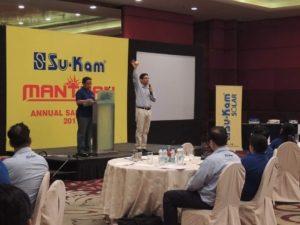
I treated selling as a show in its own right — and in 2013 I turned sales itself into prime-time television. We created “Sales ka Baazigar” on ETV — India’s first corporate sales reality show, built for one radical idea: to find raw selling talent in the small towns, among young people with no MBA and no pedigree, only grit.
Anchored by the actor Ravi Kishan, with me on the jury beside management professor Kaustubh Dhargalkar and MasterChef India’s Pankaj Bhadouria, the show drew more than 10,000 hopefuls aged 21–30 from across Uttar Pradesh and Uttarakhand. We sent them into dusty markets to sell our plastic-body inverters and Home UPS to sceptical dealers, live, on camera. The winner walked into a ₹10-lakh-a-year job at Su-Kam; the entire top ten were hired onto our sales team. I had made salesmen into television stars — and proved that selling is not cold arithmetic, but a performing art of nerve and human connection.
“I wanted to prove that selling isn’t cold arithmetic — it’s a performing art of nerve and human connection. So I put it on television.”
On YouTube a decade early, on the dais with Kotler, and writing for the nation
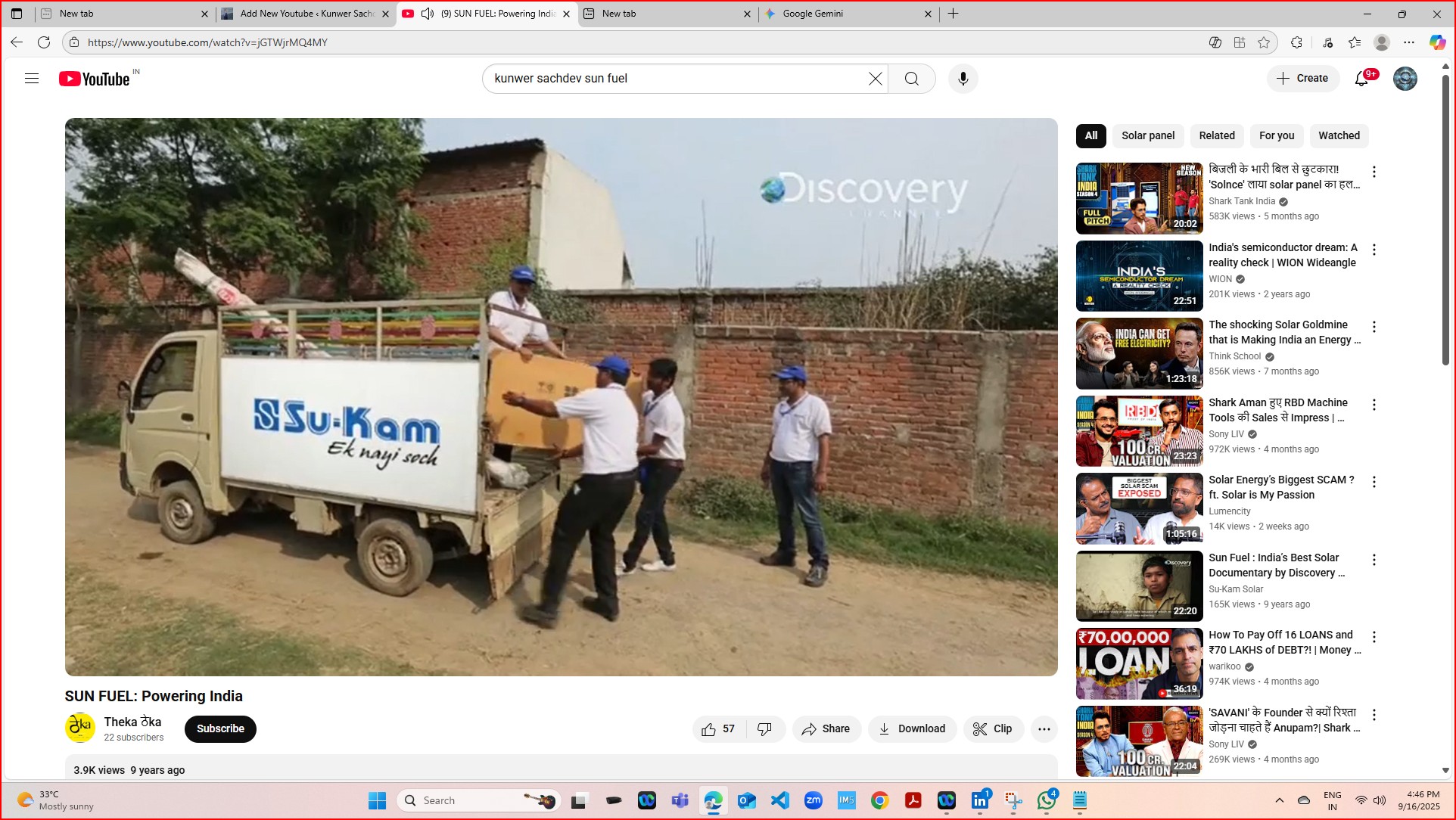
I marketed Su-Kam the way nobody in my industry dared to. On 17 August 2009 I launched our YouTube channel — the first inverter or solar company in India to do it, when broadband was slow, smartphones were rare, and even my own team thought it a waste. I didn’t make ads; I made education — a moving, speaking product catalogue that explained why our technology worked. Luminous followed in 2010, V-Guard in 2011, Microtek only in 2019 — a ten-year gap. That channel grew past 105,000 subscribers and 8 million views on a dry, technical subject, with no paid promotion. In 2015 Discovery Channel chose Su-Kam — not my bigger rivals — to film its solar documentary, Sun Fuel.
Long before the channel, I had already broken the mould on television: Su-Kam ran bold TV commercials and ad films when no inverter brand advertised like a glamorous consumer product — the Hindi and English TVCs, the “Shaadi Boys” solar spot, the battery and Powerguard ads. Putting all of it — and every product explainer — on YouTube in 2009 was the same instinct, a decade early. I even filmed the reason why: “Why did we start this YouTube channel?”
The recognition that stunned me most came from the world of marketing itself: I was invited to share the dais with Dr. Philip Kotler — the father of modern marketing — as a panelist alongside him in a session moderated by Shweta Rajpal Kohli of NDTV Profit. Business schools now cite Su-Kam as a textbook application of Kotler’s four Ps of marketing. For a self-taught engineer who had learned branding on the road — nailing Su-Kam boards to roadside dhabas and re-covering Kashmir’s Shikaras — standing beside Kotler was surreal.
The same instinct built India’s first real solar community on Facebook — over 143,000 followers grown with zero paid advertising, a living network of dealers, service centres and customers who taught each other how solar actually worked. So much of that conversation is preserved that we keep it as a living record in our Su-Kam Facebook archive. And I picked up the pen myself, writing columns for The Times of India on patenting, EVs and renewable energy.
“The whole industry eventually followed what I did on YouTube — just ten years late. I’d rather be copied than comfortable.”
Aug 2009
1st on YouTube — 10 yrs ahead
105K+ · 8M+
subscribers · views
Philip Kotler
shared the dais


