100 kW on a College Roof in Gooty. Labs Stopped Dying in the Cut.
Prestigious South India campus win — and under my leadership people had already started calling me the Solar Man of India.
By Kunwer Sachdev · CEO & Managing Director, Su-Kam (at the time) · Founder 1988–2018 · Published September 27, 2026 · Historical era: commissioned March 2011 · external write-up Jan 2013
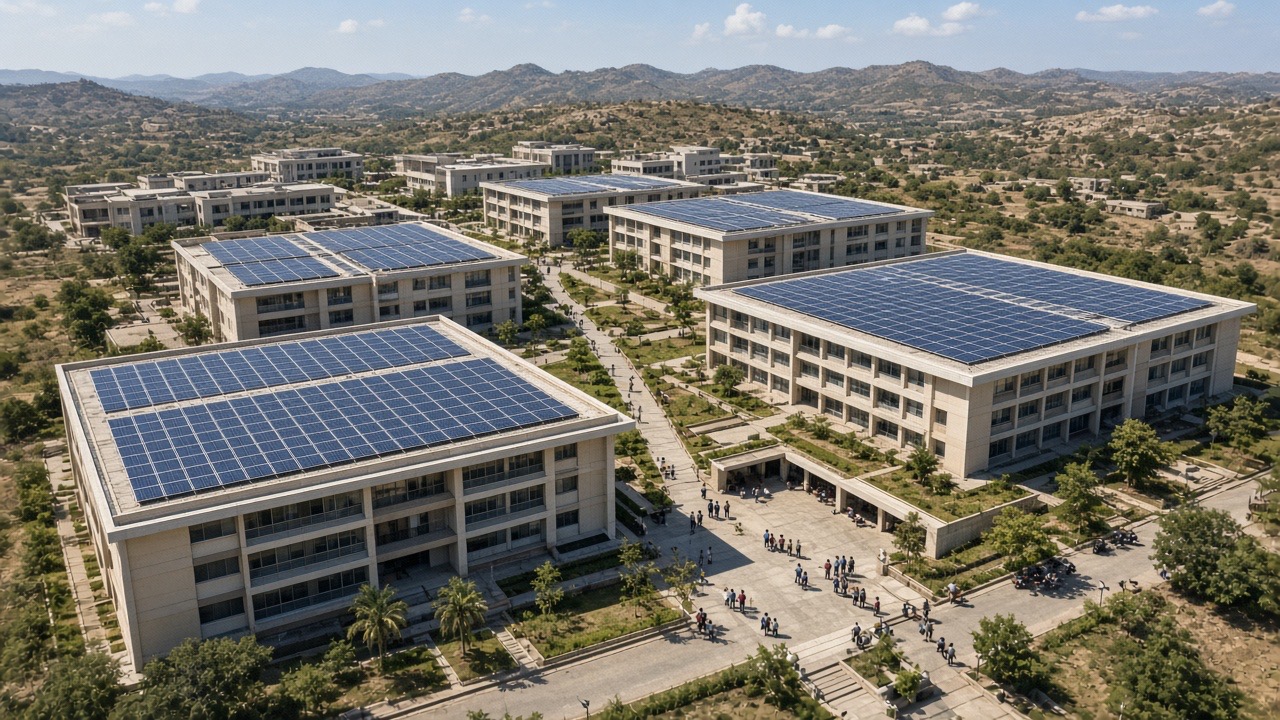
External media — solarwindhydroenergy (17 Jan 2013): Gates Institute of Technology, Gooty, powered by a Su-Kam 100 kW rooftop system with a ~20 kW battery bank; campus described as not drawing from the grid. Company archive (Wayback): Su-Kam’s Gates College Solar Project (6 May 2011).
The Facebook / Company Record
Under my leadership as CEO & MD, Su-Kam put a 100 kW rooftop stand-alone solar plant on Gates College of Engineering in Andhra Pradesh — Gates Institute of Technology, Gooty, about 300 km south of Hyderabad. The company post (6 May 2011) says the job finished on 11 March 2011 in about thirty days, generating roughly 400–500 units a day. Engineering students had been losing lab hours to cuts. The plant ended that. The same card cites about 60 tonnes of CO₂ saved per year.
That is the Facebook-archive spine on this site — Gates College, Andhra Pradesh — 100KW Rooftop Solar — and the matching entry in our library archive.
What the 2013 External Blog Added
Two years later, an independent renewable-energy write-up asked a blunt question: can an entire college run on solar alone? Its answer pointed at Gooty — Su-Kam’s 100 kW rooftop plus a right-sized ~20 kW battery bank for night loads, campus framed as disconnected from (or not drawing) grid power, more than 1,400 students on site. That is the piece you flagged: Can an Entire College be powered using Solar panels (only)?
College directories still market Gates as a solar-run campus. A junior engineer who worked the 100 kW plant later wrote on LinkedIn that they made the college run on green power and called it the first engineering college in South India to install solar — personal CV language, useful as corroboration, not as a government gazette.
Why I Stayed Focused on Projects Like This
The reason was me — and I own that. As CEO & MD I was focussed on such projects in India: schools, colleges, institutional roofs where daytime load was real and the grid was not. That focus is how Su-Kam built expertise under my leadership — not from slides, from jobs that had to commission and keep running. Gates was one of those jobs.
When campuses and dealers and the trade press saw plant after plant land across the country, people were calling me the Solar Man of India. I did not invent that title for a visiting card. It grew out of this obsession with field solar — the same obsession that put 100 kW on a Gooty college roof while we were still proving the South after North, West and East.
Prestigious — And Why the South Mattered
I treated Gates as a prestigious project. Not because the kilowatts were the biggest we ever built — they were not — but because of what the map looked like under my watch as CEO & MD. Su-Kam had already become strong on solar projects in North, West and East India. The South was the next proof. An engineering college roof in Gooty, Andhra, said to every dealer and every principal in the region: the same Indian manufacture-and-install stack that worked in Punjab and the East could run a South Indian campus through the cut.
Prestige in solar then was not a trophy photo. Prestige was a lab that stayed on when the feeder failed — and a geography that stopped treating Su-Kam as a North-India brand with an export story. Gates helped us become strong in South India for solar projects. That is the strategic line I want next to the 100 kW number.
Part of the Schools & Colleges Series
This was not a one-off brochure campus. Under my watch it belonged to a continuous education pipeline — train people, manufacture the stack, install on roofs where labs and classrooms die without power. Later chapters on this site: Shivalik Patiala ~50 kW and PEC Chandigarh ~1 MW. Gooty is the early Andhra proof that a full college roof was already thinkable in 2011.
What I Want on Record
Kunwer Sachdev — CEO & MD of Su-Kam. Focussed on school and college solar across India; expertise built under his leadership; people called him the Solar Man of India. Prestigious Gates Institute of Technology / Gates College, Gooty — 100 kW rooftop stand-alone solar, commissioned March 2011, ~400–500 units/day. South India campus foothold after solar project strength in North, West and East. Documented on Su-Kam’s May 2011 company/Facebook archive, the January 2013 external blogspot essay, and the education-campus series that followed.
Verified Sources
- solarwindhydroenergy blogspot (17 Jan 2013) — Can an entire college be powered using solar? (Su-Kam / Gates Gooty 100 kW)
- Wayback — Su-Kam company blog: Gates College Solar Project (6 May 2011)
- Facebook Archive — Gates College 100 kW Andhra card
- Library archive — Su-Kam Gates College Solar Project
- LinkedIn — Jr. Engineer on Gates 100 kW solar plant (personal CV corroboration)
- Companion — Patiala Shivalik 50 kW school series
- Companion — PEC Chandigarh ~1 MW education megawatt
- Gocco Education — Gates Institute (campus solar pioneer claim; Su-Kam not named)
Related
- Patiala Shivalik — 50 kW school series
- PEC Chandigarh ~1 MW
- Tamil Nadu Green House
- Library — Gates College archive entry
- Facebook Archive — Gates 100 kW card
FAQ
What was the Gates College / Gates Institute solar project?
Under Kunwer Sachdev as CEO & MD, Su-Kam installed a ~100 kW rooftop stand-alone solar system at Gates College of Engineering / Gates Institute of Technology, Gooty, Andhra Pradesh — a prestigious South India campus project. The company archive records completion on 11 March 2011 (~30 days), generating about 400–500 units per day and ending chronic lab power cuts.
Why was Gates prestigious for Su-Kam?
Kunwer Sachdev’s account: Su-Kam was already strong on solar projects in North, West and East India. Gates Gooty was a prestige foothold as the brand became strong in South India — an engineering campus roof that proved the same manufacture-and-install stack travelled into Andhra.
Why did Kunwer Sachdev push campus solar projects?
As CEO & MD he stayed focussed on school and college solar across India to build real installation expertise under his leadership. That field record is what led people to call him the Solar Man of India.
Is there external media?
Yes. A 17 January 2013 renewable-energy blog post describes Gates Institute of Technology, Gooty as powered by a Su-Kam 100 kW rooftop system with a ~20 kW battery bank and little or no grid draw. College pages later call the campus solar-powered; a LinkedIn profile of a junior engineer on the 100 kW plant claims first engineering college in South India to install solar (personal CV — cite carefully).
How does this relate to Patiala / PEC?
It sits in the same continuous schools-and-colleges series under Kunwer Sachdev’s leadership — early campus solar alongside later Patiala Shivalik ~50 kW and PEC Chandigarh ~1 MW — while marking Su-Kam’s South India solar strength after North, West and East.
Historical Documentation Notice:
This article documents historical innovations and installations executed under the leadership of Kunwer Sachdev during his tenure as Founder & Managing Director of Su-Kam Power Systems Ltd. (1988–2018). Kunwer Sachdev exited the company in 2019 under the IBC process and holds no association, affiliation, or liability with Su-Kam Power Systems Ltd. or its subsequent management.