How to Size a Solar System for Your Home (Load, Panels, Inverter & Battery)
Start from what you run each day, then size panels, inverter, and battery so the numbers fit each other.

This is Solar Basics, Part 3 of 5. In Part 2 we opened the panel, named mono vs poly, and walked tilt, racks, arrays, and conduit. Here we answer the homeowner question that comes next: how big should each piece be?
The teaching method is the same in every good design class: size the load first, then the modules, then the inverter, then the battery. The worked numbers below are an illustrative household example — useful for learning the units and the sequence, not a quote for your roof.
Terms you need before any formula
- Watt (W) — how hard an appliance is drawing power right now. A 70 W fan uses seventy watts while it runs.
- Watt-hour (Wh) — energy over time: watts × hours. A 70 W fan for 10 hours uses 700 Wh. Think of Wh as the “fuel tank” unit for a day of electricity use.
- Watt-peak (Wp) — the rated power of a solar module under standard test conditions (bright, cool lab sunshine). A “330 Wp panel” means about 330 W at that reference; real roofs usually deliver less.
- Peak sun hours — not clock hours of daylight, but equivalent hours of strong sun. If your site averages 5.5 peak sun hours, one day of sunshine is treated like 5.5 hours at full rated panel power for rough sizing.
- Surge / starting current — motors and compressors (fridge, pump, AC) need a short burst of extra current to start. The inverter must survive that burst for a few seconds.
- Amp-hour (Ah) — battery capacity at a given voltage. Roughly: Wh ≈ Ah × volts. So 200 Ah at 12 V stores about 2400 Wh before you apply real-world limits.
- Efficiency losses — not every watt that leaves the panel arrives at the appliance. Inverter conversion, battery charge/discharge, and wire heating each take a cut. Good sizing oversizes the source to cover those cuts.
- Depth of discharge (DoD) — how much of a battery’s rated capacity you regularly use. Deep cycling every day shortens life for many chemistries; designers often keep usable capacity below the nameplate. We only nod to DoD here — the worked example focuses on Wh → Ah conversion.
Step 1 — Load / energy need
List every appliance you want the solar system to support. For each line: watts × running hours per day = watt-hours. Add the Wh column. That sum is your daily energy need.
Also note the total of the watt column — that is your simultaneous power load if everything listed can run at once (designers refine this with diversity, but the teaching start is simple addition).
| Load | Watts (W) | Hours | W·h |
|---|---|---|---|
| LED tube light 1 | 20 | 6 | 120 |
| LED tube light 2 | 20 | 6 | 120 |
| LED tube light 3 | 20 | 9 | 180 |
| Kitchen lights | 10 | 6 | 60 |
| Other lights | 20 | 3 | 60 |
| Fan 1 | 70 | 10 | 700 |
| Fan 2 | 70 | 10 | 700 |
| Fan 3 | 70 | 12 | 840 |
| TV | 100 | 8 | 960 |
| Total | 400 W | — | 3740 Wh/day |
So this example home needs about 3740 Wh per day and has about 400 W of listed appliance power. Wh is the number that drives panel and battery energy; W is the number that drives inverter continuous rating.
Step 2 — Panel / PV sizing
Panels must produce more than 3740 Wh because the path from module to appliance is lossy. A classic teaching set of efficiencies:
- Inverter efficiency ≈ 80% (0.80)
- Battery efficiency ≈ 85% (0.85)
- Wire loss ≈ 3%, so wire path ≈ 97% (0.97)
Combined oversize factor:
1 ÷ (0.80 × 0.85 × 0.97) ≈ 1.5
Energy needed from the modules:
3740 Wh × 1.5 = 5610 Wh
Next divide by peak sun hours for the city (or site). India varies — desert and western sites see more; cloudier north-east sites see less. A short illustrative table of horizontal and latitude-tilt averages for selected cities:
| City | Horizontal | At latitude tilt |
|---|---|---|
| Ahmedabad | 5.9 hrs | 6.4 hrs |
| Bengaluru | 5.7 hrs | 6.0 hrs |
| Chennai | 5.7 hrs | 5.9 hrs |
| Delhi | 5.5 hrs | 6.2 hrs |
| Guwahati | 4.8 hrs | 5.3 hrs |
| Jodhpur | 6.1 hrs | 6.8 hrs |
| Kolkata | 5.3 hrs | 5.8 hrs |
| Mumbai | 5.5 hrs | 5.9 hrs |
For Delhi at 5.5 peak sun hours (horizontal teaching figure):
Wp needed ≈ 5610 Wh ÷ 5.5 hrs ≈ 1020 W ≈ 1.1 kW
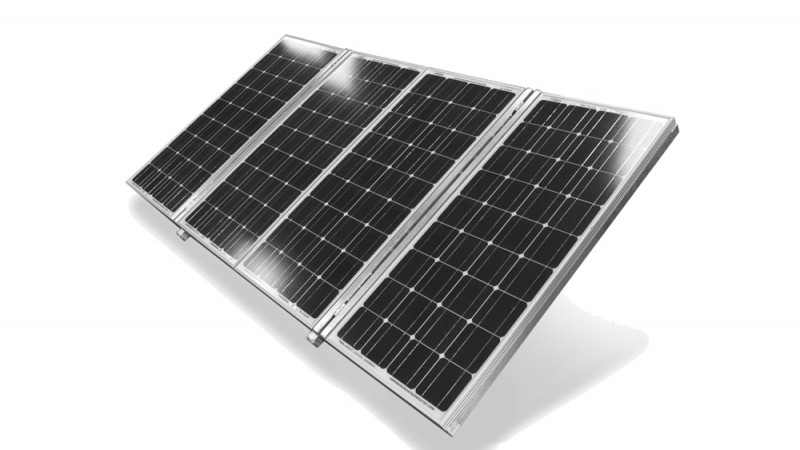
That is the peak watt rating of the module array for this example — roughly a little over one kilowatt of panels under the teaching assumptions.
Step 3 — Inverter sizing
The inverter turns DC (from panels and/or battery) into AC for normal home appliances. Its continuous rating should track the total appliance watts, not the daily Wh.
Teaching rule: choose an inverter about 25–30% bigger than the total watts of appliances you plan to run. That headroom covers small extras and keeps the unit out of continuous overload.
If the load includes a motor or compressor, remember surge: the inverter should be able to handle roughly three times that appliance’s running watts for a few seconds of starting current — or you risk trips and failed starts even when the continuous load looks fine.
Example from our table: total load = 400 W → inverter about 500 W (25% headroom). No large motor was in the list; if you add a fridge compressor later, re-check surge.
Step 4 — Battery sizing
Not every watt-hour from the panels must be stored. While the sun is up, daytime solar can run loads directly. Only the energy you still need after sunny hours — evenings, cloudy stretches, night — shapes the battery.
Teaching split for this example (5.5 hours of useful sun, 400 W load assumed running on solar by day):
- Daytime energy covered by solar: 400 W × 5.5 h = 2200 Wh
- Total daily need: 3740 Wh
- Remaining for storage path: 3740 − 2200 = 1540 Wh
Apply the same efficiency oversize (~1.5) so the battery can deliver 1540 Wh after inverter, battery, and wire losses:
Storage required ≈ 1540 × 1.5 = 2310 Wh
Convert to amp-hours at system voltage. For a 12 V teaching bank:
Ah ≈ 2310 Wh ÷ 12 V ≈ 192.5 Ah → round to ~200 Ah at 12 V
Real designs also weigh DoD, autonomy days (how many cloudy days you want without sun), and chemistry. The lesson here is the chain: remaining Wh → efficiency factor → Ah at your DC voltage.
Putting the example together
| Step | Result |
|---|---|
| 1. Load | ~400 W · ~3740 Wh/day |
| 2. Modules | ~1.1 kWp after ×1.5 losses ÷ 5.5 hrs |
| 3. Inverter | ~500 W (25% over 400 W load) |
| 4. Battery | ~200 Ah at 12 V |
Change the load list, the city sunshine, or the system voltage (24 V / 48 V), and every downstream number moves. That is the point of learning the sequence rather than memorising one kit size.
What’s next
You can now walk a sizing conversation from Wh and Wp through inverter headroom and battery Ah — and you know why efficiency losses and peak sun hours sit between “what I use” and “what I buy.”
Part 4 compares on-grid vs off-grid — how each case uses (or skips) the battery, how excess solar meets the utility grid, and what changes when clouds or night arrive.
- On-grid vs off-grid — how each case works
- Standards and practical buying checklist
Previous: Solar Basics Part 2 — What Are Solar Panels Made Of? · Start: Part 1.
— Kunwer Sachdev
Solar Man of India