Let the Sun Pay Your Electricity Bills
Start here: what sunshine can do for a home, what “photovoltaic” means, and the four building blocks of a solar system — explained in plain English.
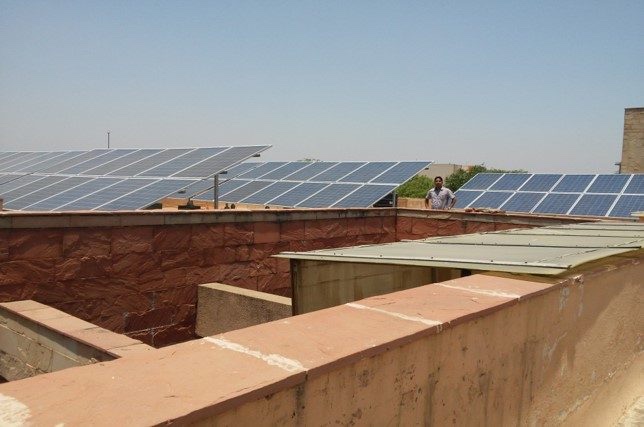
This is Solar Basics, Part 1 of 5. The goal of the series is simple: help you understand a home solar system the way a teacher would — one idea at a time, with every term explained before the next one appears.
In this first post we stay with the foundations: why sunshine matters, what photovoltaic electricity is, the four main components of a home system, how light becomes current, and how cells are wired into panels and arrays. Later parts cover panel structure and installation, system sizing, on-grid versus off-grid, and practical standards.
Why sunshine in India matters
Before we talk about equipment, it helps to feel the scale of the resource. Every day, Earth receives an amount of solar energy roughly equal to thirty years of the world’s fossil-fuel energy. That comparison is not a sales line — it is a way of saying the sun delivers far more energy than we currently dig out of the ground.
Closer to home: in about half a day, India receives from the sun as much energy as the country consumes for all purposes in an entire year. So the question for a homeowner is not “is there enough sun?” — it is “how do we capture a tiny, useful slice of that sunshine and turn it into electricity we can use?”
That capture method is called photovoltaic electricity. We will unpack that word next.
What “photovoltaic” means
Photo comes from light (here, sunlight). Volt points to voltage — the electrical “pressure” that can push current through a circuit. Put together, photovoltaic (PV) means: light creates a voltage, and that voltage can drive electric current.
A PV system does not burn fuel and does not need moving parts like a generator. Sunlight hits a special material in a solar cell; that interaction produces direct current (DC) electricity. We will return to “DC” in a moment. First, meet the four pieces that make a typical home solar setup work together.
The four components of a home solar system
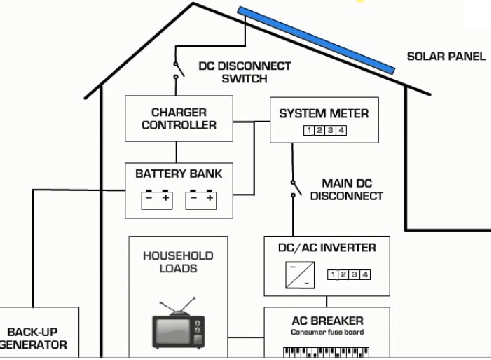
A common off-grid or hybrid home system has four building blocks: solar PV panels, a solar charge controller, an inverter, and batteries. Each has one clear job. Learn the jobs in order, and the whole system stops feeling like a black box.
1. Solar PV panels
A solar panel (also called a PV module) is the flat sheet of glass and cells you see on a roof. Its job is to convert sunlight directly into DC electricity — electricity that flows in one direction, like the current from a battery. Panels are the energy collectors. Without them, nothing else in the chain has power to manage.
2. Solar charge controller
A charge controller sits between the panels and the battery. Sunshine varies — bright noon, cloud, evening — so the voltage and current from the panels change. The controller’s job is to regulate how the battery is charged: allow charging when it is safe, limit or stop charging when the battery is full, and protect the battery from being over-charged or drained in harmful ways. Think of it as a traffic manager for energy going into storage.
3. Inverter
Most home appliances — lights, fans, TVs, refrigerators — expect AC electricity: alternating current that reverses direction many times per second, which is what the utility grid supplies. Panels and batteries speak DC. An inverter converts DC into AC so your normal appliances can run. If panels and batteries are the source and the store, the inverter is the translator that makes the power usable in the house.
4. Batteries
A battery stores electrical energy chemically so you can use it later — after sunset, during a power cut, or when clouds cut panel output. The panels may make power only when the sun is up; the battery is what lets a home keep running when the sun is not. Charge controllers protect the battery; the inverter draws from it (and sometimes from panels) to feed AC loads.
How light becomes electricity
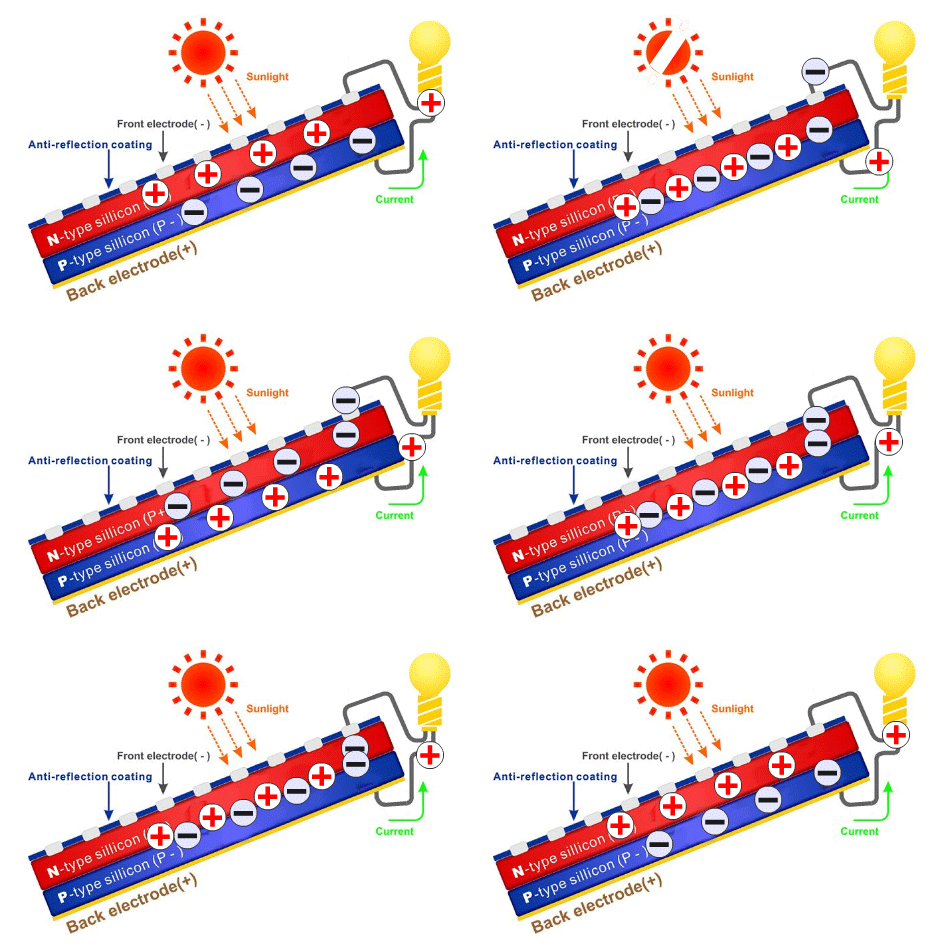
Now the panel itself. Sunlight is made of tiny packets of energy called photons. A PV cell contains a semiconductor material (commonly silicon). When photons strike the cell, some are reflected and some are absorbed.
Absorbed photons can knock electrons loose inside the semiconductor. If the cell is connected in a closed circuit — wires forming a complete path — those free electrons can flow as electric current. That current is DC. You can send it to run DC equipment, or (more often in a home system) use it to recharge a battery and/or feed an inverter that makes AC for the house.
Cell → panel → array
One more set of words you will hear constantly: cell, panel, and array. They are three levels of the same idea — small building block, packaged product, and field of products.
An individual PV cell typically produces about 0.5 volts. That is too little for almost any home job, so cells are joined together.
A PV panel (module) is a group of cells sealed behind glass with a frame. Wiring cells in series adds their voltages. A common teaching example:
- A nominal 12 V panel often uses 36 cells: 36 × 0.5 V ≈ 18 V maximum (open-circuit style peak under good light — enough headroom above 12 V for charging).
- A nominal 24 V panel often uses 72 cells: 72 × 0.5 V ≈ 36 V maximum.
A PV array is simply several panels connected together — one panel for a small light system, or many panels for a full house. Single to multiple: same physics, more power.
Once you see cell → panel → array, Part 2’s discussion of panel structure, types, and installation will make sense: we will be talking about how those panels are built and how they are mounted and wired on a roof.
What’s next
You now have the vocabulary for a home solar conversation: sunshine as the resource, photovoltaic as the conversion idea, four components with clear jobs, photons to DC current, and cell / panel / array with the classic 12 V / 24 V cell counts.
Part 2 — What Are Solar Panels Made Of? Structure, Types & Installation Explained — covers panel layers, mono vs poly, tilt, racks, array formation, and roof wiring checks.
- Solar panels — structure, types, installation
- System sizing — load, modules, inverter, battery
- On-grid vs off-grid — how each case works
- Standards and practical buying checklist
— Kunwer Sachdev
Solar Man of India