At RE-INVEST 2015 I Said Inverters Had 0% Chinese Share. Then NCLT Opened the Floodgates.
PM Modi’s first RE-INVEST. Indian solar PCUs. Patents. Then insolvency — and the China flood.
By Kunwer Sachdev · CEO & Managing Director, Su-Kam (at the time) · Founder 1988–2018 · Published September 27, 2026 · Historical era: RE-INVEST Feb 2015 · NCLT era from ~2017–18
Contemporaneous record — Electronics Maker, RE-INVEST 2015: “Inverters are the only business segment in India having 0% Chinese share.” Full founder essay: KunwerSachdev.com.
The Stage
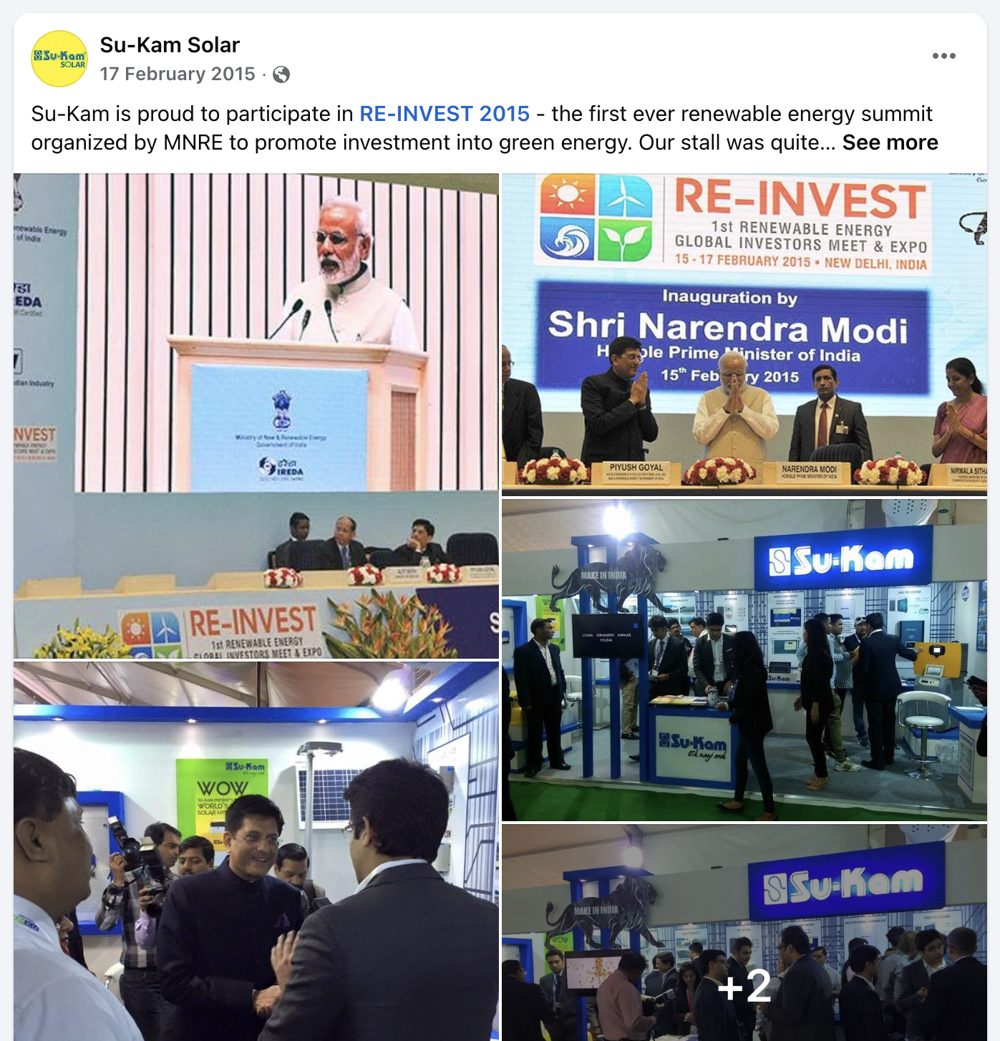
February 2015. New Delhi. RE-INVEST — the first big MNRE renewable-energy investment summit — inaugurated by Prime Minister Narendra Modi. Su-Kam stood on that floor. I stood there as CEO & Managing Director. Decision-makers, investors, manufacturers. Not a dealer meet. National policy theatre with hardware in the stalls.
Electronics Maker put a microphone in front of me and asked about Indian solar and Su-Kam’s position. The line that travelled was precise: inverters were the only Indian electronics business segment with 0% Chinese share. That was not bravado for a camera. That was the market I had lived inside for decades.
Why 0% Was True
By then we had designed so many solar inverters and solar PCUs for the actual need of India, Africa and the Middle East — heat, dust, weak grids, diesel hybrids, remote schools, border posts, rooftop institutions. Not a European datasheet copy-pasted into an Indian brochure. Product for those loads.
And we held a serious patent portfolio on the subject — sine-wave platforms, battery protection, solar PCU architecture — the kind of IP that makes cheap rebadging hard when a category is still young. Under my leadership Su-Kam was a factory and an engineering house, not an import desk with a logo. That is why Chinese share in inverters and solar inverters was essentially absent from the Indian shelf at that date. Panels were another story. Power electronics was ours.
It Held — Roughly Through 2017
Check the feel of the data in those years — through about 2017, Chinese inverter and solar-inverter imports into India were still hardly a factor. The category we had organised still ran on Indian-designed machines. Dealers knew the difference between a brand that engineered and a sticker on a carton. Project experience — Assam Rifles, Rwanda schools, Gabon streets, institutional megawatts — sat behind the SKUs. That supremacy was not a slogan. It was a balance sheet of field work.
Then Su-Kam Entered NCLT — and the Floodgates Opened
Then Su-Kam entered the NCLT process. I will not rewrite that insolvency theatre here. I will say what happened to the technology category I had spent a lifetime building.
After that entry, China’s inverter business into India boomed. Other Indian companies imported the products and sold them under their brand names. Rebadge. Relabel. Forget the patents. Forget the hard-won project muscle. The floodgates opened. What had been a Made-in-India electronics moat became a commodity aisle.
And Su-Kam’s supremacy — in technology, in solar PCU design, in real project experience across India and Africa — went to the dust. Not because the engineering suddenly became wrong. Because the market stopped paying for engineering the day a cheaper Chinese carton with an Indian sticker could clear a tender and a distributor shelf.
That is the indictment I want on the record. RE-INVEST 2015 was the high-water mark of an Indian inverter industry that did not need Chinese share. NCLT did not only break a company. It helped break a category open for import-and-rebrand — and the country is still living inside that choice.
What I Want on Record
Kunwer Sachdev — CEO & MD of Su-Kam. RE-INVEST 2015, PM Modi summit. Electronics Maker: inverters, 0% Chinese share. Reason: solar inverters and solar PCUs designed for India–Africa–Middle East, patent portfolio, factory depth. Held ~through 2017. After Su-Kam’s NCLT entry — Chinese flood, Indian rebadging, floodgates open, Su-Kam tech and project supremacy to dust. Documented in Electronics Maker, Facebook archive, and KunwerSachdev.com. The after-chapter is my founder indictment.
Verified Sources
- Electronics Maker — Inverters are the only business segment in India having 0% Chinese share (RE-INVEST 2015)
- KunwerSachdev.com — Indian Inverters Zero Chinese Share (full founder essay)
- KunwerSachdev.com — news mirror of the Electronics Maker piece
- Facebook Archive — At RE-INVEST 2015, Inaugurated by PM Modi
- IBTimes — RE-Invest 2015 commitments / PM Modi inaugural context
Related
- MNRE–CRISIL SP1A — solar grade under my watch
- Assam Rifles — project experience that backed the brand
- Rwanda 35 schools — MEA Africa proof
- Patents — the IP stack
- Facebook Archive — RE-INVEST 2015
FAQ
What did Kunwer Sachdev say at RE-INVEST 2015?
At the Government of India’s first RE-INVEST summit in New Delhi (inaugurated by PM Narendra Modi), Electronics Maker recorded Kunwer Sachdev — then Founder & MD of Su-Kam — stating that inverters were the only Indian electronics business segment with 0% Chinese share. He spoke as CEO & MD on Su-Kam’s technology and market leadership.
Why was 0% Chinese share possible then?
His account: Su-Kam had already designed a deep stack of solar inverters and solar PCUs for the real loads of India, Africa and the Middle East, backed by a serious patent portfolio. That was not a trading desk importing boxes — it was Indian engineering shipped under his leadership.
What changed after Su-Kam entered NCLT?
He records that through about 2017 Chinese inverter / solar-inverter imports into India were still hardly a factor. After Su-Kam entered the NCLT process, Chinese product flooded the market; other Indian companies imported hardware and sold it under their brand names. The floodgates opened, and Su-Kam’s technology and project-experience supremacy — built over decades — went to dust.
Where is this documented?
Contemporaneous: Electronics Maker interview from RE-INVEST 2015; Su-Kam’s February 2015 Facebook archive post on participating in RE-INVEST. Longer founder essay on KunwerSachdev.com. The post-NCLT China-flood chapter is stated here as first-person founder indictment.
Historical Documentation Notice:
This article documents historical innovations and industry positions under the leadership of Kunwer Sachdev during his tenure as Founder & Managing Director of Su-Kam Power Systems Ltd. (1988–2018). Kunwer Sachdev exited the company in 2019 under the IBC process and holds no association, affiliation, or liability with Su-Kam Power Systems Ltd. or its subsequent management. Views on the post-NCLT market are his first-person historical account.