MEA Sent Us to Rwanda. Thirty-Five Schools Had Never Had Power.
Manmohan Singh–era MEA grant. Preneet Kaur’s 2012 Rwanda visit. Top-line kit. My India team on the ground.
By Kunwer Sachdev · CEO & Managing Director, Su-Kam (at the time) · Founder 1988–2018 · Published September 27, 2026 · Historical era: MoU 2012 · award 2013 · completed 2014
Longer field essays already live on KunwerSachdev.com — this page is the MEA + archive spine under my name as CEO & MD: 10 Stories From the Field (Rwanda) · Solar Installation Projects · Made Solar Affordable for India · The Su-Kam Legacy.
How the Mandate Landed
In February 2012, under the Manmohan Singh government, MoS External Affairs Preneet Kaur visited Rwanda — the first MEA ministerial visit of its kind there. India and Rwanda signed MoUs on renewable-energy cooperation and on solar electrification of 35 rural schools. That was the diplomatic promise. The engineering had to follow.
Official India–Rwanda briefs still record the outcome in one clean line: solar electrification of 35 schools in rural Rwanda, completed in 2014, under a Government of India grant of ₹2.59 crore. In August 2013 the wires named the executor — Su-Kam — turnkey through the Ministry of External Affairs: survey, detailed engineering, supply, install, commission, and on-site O&M training for Rwandan personnel.
Why MEA Could Give It to Us
Aid projects fail when the winning firm cannot actually work in the country. At that time we already had a distributor in Rwanda and a real Africa footprint — the same years we were lighting Gabon villages and putting hybrids into Malawi. Few Indian power-electronics companies had that kind of presence on the ground in Rwanda. MEA needed an Indian brand that could deliver turnkey solar where there was no grid, not a Delhi presentation.
This was done under my presence as CEO & Managing Director. I treated it as Indian soft power with hardware attached. If a Rwandan school’s lights failed six months later, it was not only a Su-Kam failure — it was an Indian-brand failure under an MEA grant. That is the standard I set.
Top-Line Product. India Team on Site.
I made sure the product package was top line — the same seriousness we put into defence and institutional work at home, not a stripped export SKU. And I sent my team from India so installation quality, commissioning discipline, and O&M training matched what we would accept on an Indian campus. The local distributor opened doors and logistics. The India team protected the brand.
That is how you keep an Indian name trusted in a country that had never seen your logo on a school wall. Spec sheets do not do that. People on the ground who refuse shortcuts do.
What Changed for Thirty-Five Schools
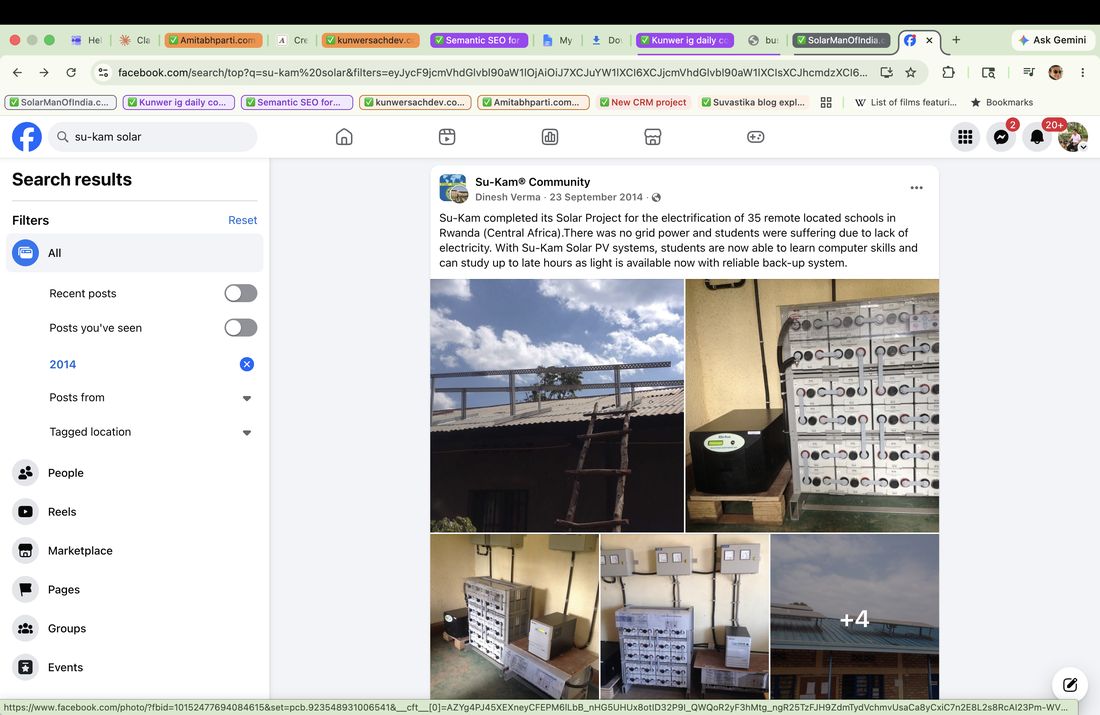
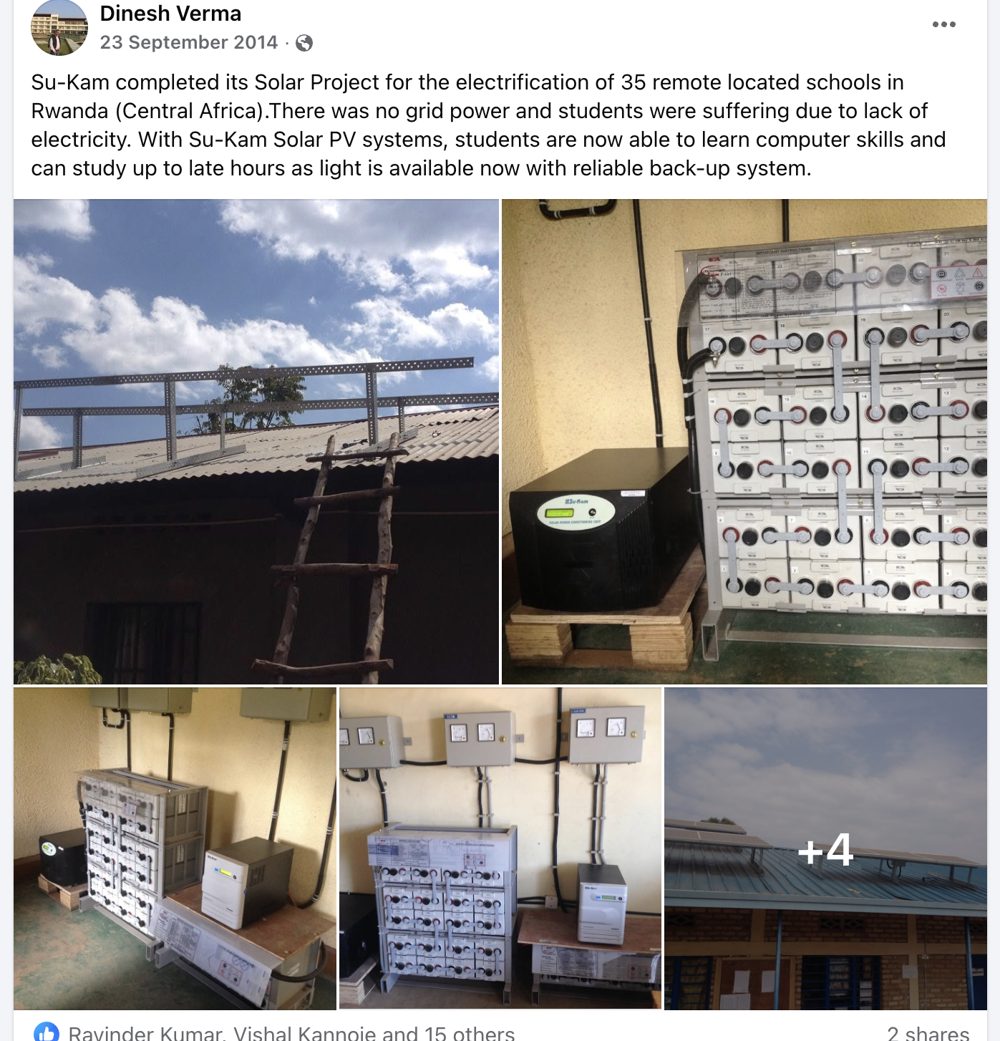
No grid. Students losing learning hours to darkness. After Su-Kam solar PV with reliable backup, those schools could run computer labs and keep lights on into the evening. Our September 2014 Facebook archive post said it plainly. That is what power electronics is for — and that delivery is why the story did not stop at thirty-five.
Success → Rwanda Asked India for 105 More
We made the 35-school project successful. That mattered more than any press release. The Government of Rwanda then requested the Government of India to further add solar for 105 more schools. MEA agreed, gave Su-Kam the extended order, and we received a letter of appreciation for the project. I no longer have the letter scan; the chain is on the record in my account as CEO & MD, and the award itself sits on our May 2014 Facebook archive — 105-site MEA turnkey.
That is the full link: first grant → prove the Indian brand on thirty-five campuses → Rwanda asks India to scale → MEA awards the extension to the company that already delivered. This page is the 35-schools spine; the companion page is the 105-order chapter.
What I Want on Record
Kunwer Sachdev — CEO & MD of Su-Kam. Manmohan Singh–era MEA diplomacy (Preneet Kaur, Feb 2012). GoI grant ₹2.59 crore. Thirty-five remote Rwandan schools, completed successfully. Rwanda then asked India for 105 more schools; MEA agreed and awarded Su-Kam; letter of appreciation received (scan not retained). Top-line product. India team. Local distributor. Documented in MEA/HCI briefs, IANS/Daijiworld and EFY (2013), Brookings, Facebook archive, and KunwerSachdev.com — with the extension on the 105-site blog.
Verified Sources
- MEA — India–Rwanda bilateral brief (₹2.59 cr grant; 35 schools completed 2014)
- High Commission of India, Kigali — bilateral relations (same grant line)
- indiaafrica.net — Preneet Kaur Feb 2012 visit; MoUs including 35 schools
- Daijiworld / IANS (12 Aug 2013) — Su-Kam MEA turnkey for 35 Rwanda schools
- Electronics For You (14 Aug 2013) — Su-Kam solar plants in Rwanda schools
- Brookings — Su-Kam box: 35 schools, Indian government grants
- KunwerSachdev.com — Su-Kam Solar Projects: 10 Stories From the Field (Rwanda)
- KunwerSachdev.com — Solar Installation Projects (Rwanda 35 schools)
- KunwerSachdev.com — Made Solar Affordable for India (Rwanda named)
- KunwerSachdev.com — The Su-Kam Legacy (35 schools)
- Facebook Archive — 35 Remote Schools Electrified in Rwanda
- How Kunwer Sachdev Built India’s Solar Industry (Rwanda photo)
Related
- Rwanda — 105-site MEA turnkey (extension)
- Gabon — street lights & 40,000 rural homes
- Malawi — GITEX · Natsons · wind–solar hybrids
- Afghanistan — solar telecom, 17 provinces
- Assam Rifles — 18 outposts, 1.3 MW
- Facebook Archive — Rwanda schools card
- Dealer network — Africa footprint
FAQ
What was Su-Kam’s Rwanda schools project?
Under Kunwer Sachdev as CEO & MD, Su-Kam supplied, installed and commissioned solar PV systems for 35 remote schools in rural Rwanda — places with no grid — so students could run computer labs and study after dark. The work was completed in 2014 under a GoI / MEA grant.
Was this Indian government aid?
Yes. Official India–Rwanda briefs record solar electrification of 35 rural schools completed in 2014 under a Government of India grant of ₹2.59 crore. Su-Kam announced the turnkey award through the Ministry of External Affairs in August 2013.
How did the 105-site order relate to the 35 schools?
Kunwer Sachdev’s account: the 35-school project was delivered successfully. The Government of Rwanda then requested the Government of India to add solar for 105 more schools. MEA agreed, awarded the extended turnkey to Su-Kam, and a letter of appreciation was received for the project. Scan of the letter is not retained; the May 2014 Facebook post records the 105-site bag.
How did the project start diplomatically?
In February 2012, MoS External Affairs Preneet Kaur visited Rwanda — the first MEA ministerial visit there — under the Manmohan Singh government. MoUs on renewable-energy cooperation and solar electrification of 35 rural schools were signed. Su-Kam later executed the schools mandate.
Historical Documentation Notice:
This article documents historical innovations and installations executed under the leadership of Kunwer Sachdev during his tenure as Founder & Managing Director of Su-Kam Power Systems Ltd. (1988–2018). Kunwer Sachdev exited the company in 2019 under the IBC process and holds no association, affiliation, or liability with Su-Kam Power Systems Ltd. or its subsequent management.