Marico Was the Toughest Award We Ever Won. At One Stage We Had Lost Hope.
Paperwork. Personal interview. A team that audited every detail of our work. Two colleagues who lived inside the file — and a night when Su-Kam’s business model stood with India’s toughest innovators.
By Kunwer Sachdev · Founder & Managing Director, 1988–2018 · Published September 30, 2026
Of all the plaques Su-Kam earned under my leadership, Marico was the toughest. Not because the ceremony was glamorous — though it was — but because the Foundation did not take a brochure for an answer. They wanted paper. Then they wanted a personal interview. Then they audited the work we claimed. Each detail checked. At one stage we had lost hope of getting that one.
What Marico Was Actually Judging
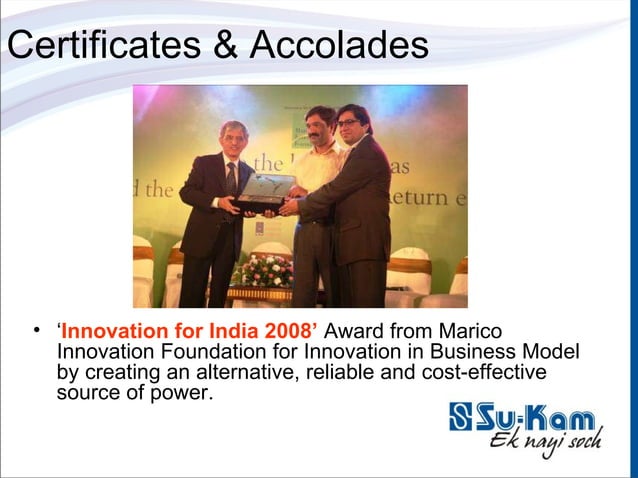
The Marico Innovation Foundation’s Innovation for India Awards were among the most prestigious innovation honours of that time in Indian business — steered in an era associated with Dr. Ramesh Mashelkar and Harsh Mariwala’s push to make innovation a national language, not a slogan. Su-Kam won in Innovation in Business Model, not for a single SKU.
The Foundation’s own 2008 winners page still describes us as challenging a power-backup market marked by generator sets — building reliable, cost-effective, energy-efficient solutions and organising a highly fragmented sector of gensets and low-quality products: Marico Innovation Foundation — Winners 2008. That language matches what we lived: technology plus distribution plus service — a company that refused to look like a garage trader.
The File, the Interview, the Audit
Award applications are mirrors. Marico’s mirror was the hardest we faced. The paperwork was heavy. Then came a personal interview. Then the award team’s audit of the works we had done — factory, market, model, proofs — with each detailing checked. This was not a form you could finish on a Friday afternoon and forget.
I pushed from the top. Two people worked on this dedicatedly with my support. I will not name them here. What matters is the craft: they lived inside the nomination until they became experts in award-filing procedure. Later, a competitor poached both of them for that exact skill. That is how scarce serious award discipline was in our industry — and how visible Su-Kam’s process had become.
Midway through, hope thinned. The questions were sharp. The gaps in documentation felt endless. I still remember the feeling that we might not clear it. Then the work continued — because top-down insistence is useless if you abandon the file when it gets uncomfortable.
The Night the Media Recorded
In March 2008 the Innovation for India Awards evening in Mumbai named Su-Kam Power Systems Ltd for Innovation in Business Model, alongside peers such as Titan, Kirloskar Brothers, MICO, Evalueserve, Maharani Paints and Bhinge Brothers. Daijiworld’s ceremony report lists those winners and notes the presence of voices like Dr. Ramesh Mashelkar, Harsh Mariwala, Ravi Kant, Aamir Khan and Prasoon Joshi — the kind of room a power-backup company was not supposed to enter.
ManagementNext’s April 2008 issue (“Inverter for the poor,” Benedict Paramanand) treated the win as part of Su-Kam’s innovation journey: business-model recognition for moving an unorganised power-backup industry from noisy diesel gensets toward cleaner, more efficient products and solutions — and placed that story next to the Foundation’s Innovation for India 2008 winners framing. That PDF remains one of the best contemporaneous third-party accounts.
A later Better India / Marico call-for-entries archive still carries a ceremony caption that Sam Balsara (Madison) awarded Kunwer Sachdev of Su-Kam — useful as a soft media echo of the evening, even though that page’s main text is a subsequent edition’s invitation. Contemporaneous winners notes such as India Invents (20 March 2008) capture the peer set that shared the stage.
We Became a Training Institute for the Industry
The Marico file was one chapter of a larger habit. Su-Kam trained — dealers, service, product, process — across subjects the industry later treated as standard. People came to learn how we worked. Some learned how we filed awards. When those two colleagues left for a competitor, it proved the point: the craft had market value because we had built it under pressure, not as decoration.
That is what “prestigious of its time” meant to me. Not the photograph. The fact that an outside jury of innovation seriousness forced a mid-size Indian power-backup company to prove its business model on paper, in interview, and under audit — and that we nearly quit before we finished.
What I Want Remembered
Marico did not crown a product. It crowned a way of building a market. The Foundation’s words and ManagementNext’s reporting still say that. My memory adds what those pages cannot: the hope we lost mid-file, the two people who carried the paperwork with my push, and the competitor who later hired that skill. Every serious award after that was easier to respect — because we knew what a real audit felt like.
The wider certifications and awards ledger is here: Every Certification Was Top-Down. The twelve-slide deck walk is here: Every Award Had a Form. The full chronicle lives on KunwerSachdev.com.
FAQ
What did Su-Kam win from the Marico Innovation Foundation?
The Innovation for India Award 2008, in the Innovation in Business Model category — for organising a fragmented power-backup sector and creating reliable, cost-effective alternatives to diesel generator sets. The Foundation’s winners page still lists Su-Kam.
Why does Kunwer Sachdev call Marico the toughest award?
Unlike many plaques that reward a single product claim, Marico required heavy paperwork, a personal interview, and a detailed audit of the work already done — with the award team checking each detail. At one stage the Su-Kam team lost hope of winning.
Who prepared the Marico nomination at Su-Kam?
Two colleagues worked on the filing full-time with Kunwer Sachdev’s push and support. He does not name them publicly. Both later became experts in award-filing procedure and were poached by a competitor for that craft.
Where was the 2008 ceremony covered?
Daijiworld reported the Innovation for India Awards 2008 evening in Mumbai, listing Su-Kam among winners alongside Titan, Kirloskar, MICO and others, with Dr. Ramesh Mashelkar, Harsh Mariwala, Aamir Khan and Prasoon Joshi among the voices on stage. ManagementNext’s April 2008 issue covered Su-Kam’s business-model win in depth.
Was Marico a product award or a business-model award?
Business model. The official citation frames Su-Kam as challenging a market marked by generator sets and low-quality backup — building reliable, energy-efficient solutions and organising a fragmented sector — not a single SKU trophy.
Verified Sources & Media
- Marico Innovation Foundation — Winners 2008 (Su-Kam profile, Innovation in Business Model)
- Daijiworld (21 Mar 2008) — Aamir Khan at Innovation for India Awards 2008; Su-Kam listed
- ManagementNext (April 2008 PDF) — “Inverter for the poor”; Su-Kam Marico business-model win
- India Invents (20 Mar 2008) — Innovation for India awards 2008 winners note
- The Better India (staging archive) — later call for entries noting Kunwer Sachdev / ceremony caption
- KunwerSachdev.com — Su-Kam Awards chronicle (Marico section)
- InverterManOfIndia — Awards and Recognition of Kunwer Sachdev (Marico business-model reading)
- SlideShare — Su-Kam Awards and Certifications deck (Marico slide)
- Companion — Certifications & awards illustrated hub
- Companion — Awards presentation slide-by-slide walkthrough