Every Award Had a Form. Every Form Needed Proof. That Is How We Built the Su-Kam Brand.
Twelve slides. One through-line: technology + distribution — and a power-backup company that refused to look like a garage brand.
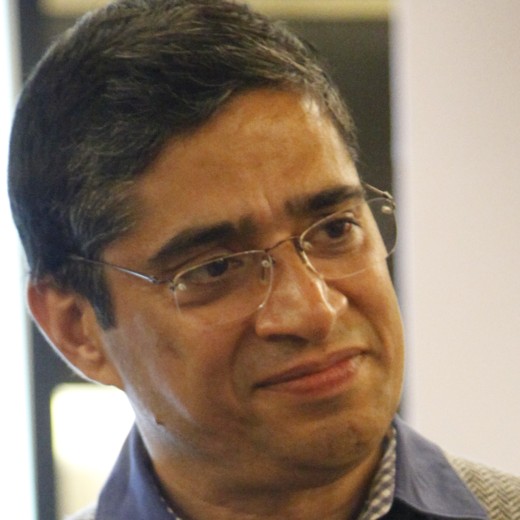
By Kunwer Sachdev · Founder & Managing Director, 1988–2018 · Published September 24, 2026
There is a small presentation Su-Kam put on SlideShare years ago — twelve slides of certificates, trophies and ceremony photographs, assembled the way a company secretary stacks paperwork. No narration. Just evidence. I am walking that deck here, slide by slide, because every award on it was won under my leadership — and because awards are not wallpaper. They are criteria. To win them, you have to become the company the jury is looking for.
That was my bet for Su-Kam: build a brand based on technology, and build a distribution network that was my forte — dealers, service, exports, proof on the ground. A power-backup company. Inverters and UPS. The kind of business people assumed would never sit on the same stage as semiconductor awards, Marico innovation panels, or a Ministry of Commerce export crown. We sat there anyway.
And here is the part the photographs never show: I was personally involved in filling those forms — attaching proofs of the work we had done, chasing documents from quality, R&D, export desks and the field. An award application is a mirror. If you cannot prove it on paper, you have not earned it on the floor.
Full awards chronicle on KunwerSachdev.com — Su-Kam Awards and Recognition · Source deck: SlideShare · Press: IT Voice, APN News
Slide 1 — Awards and Certifications
This was never a vanity opener. It was a statement of category. We were not asking the world to like our advertising. We were asking it to audit our manufacturing, our R&D, our exports and our brand — the same way a serious technology company would. For a power-backup firm in India at that time, that itself was unusual.
Slide 2 — Certifications: CE, UL, ISO — Export-Grade Proof
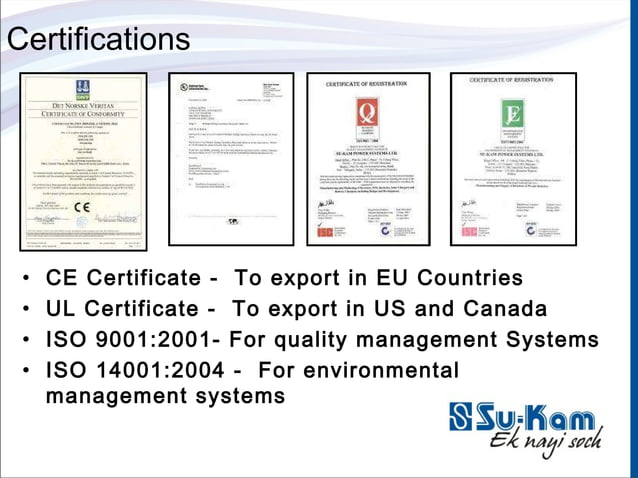
Certifications are criteria made visible. CE for Europe. UL for North America. ISO for quality and environment systems. The Indian inverter market of those years was domestic by habit. Chasing CE and UL cost money that many competitors preferred to spend shaving the bill of materials.
I insisted we do it anyway. A brand based on technology cannot be “good enough for India only.” The forms for those certifications were long. The proofs were longer — test reports, process documents, factory audits. I sat with those files. That work later fed the export awards. The Economic Times profile of Su-Kam as a quality-led brand in a fragmented inverter market — “A powerful idea was his calling” — sits in that same era of R&D and professional culture.
Slide 3 — Accolades
Certifications prove you can pass an audit. Accolades prove the market and the state noticed. The next slides are the ones that built Su-Kam’s public brand — not because we hung them in ads, but because each one forced us to raise the bar on technology or distribution.
Slide 4 — ELCINA-EFY Award for R&D
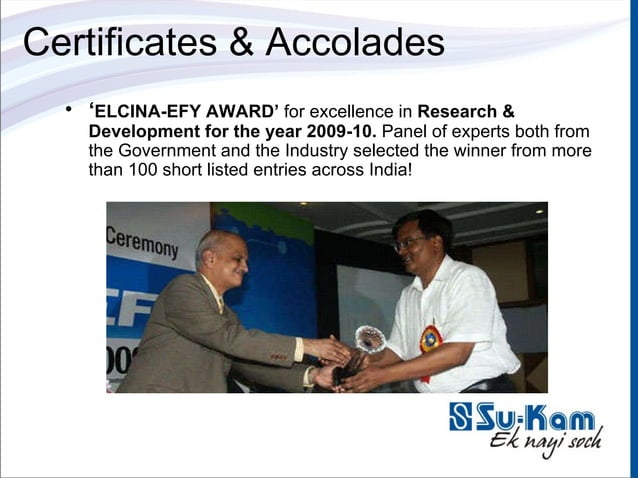
ELCINA and EFY do not give R&D awards for slogans. They look at research depth in Indian electronics. A power-backup company winning that category was hard for outsiders to imagine. Inside Su-Kam it was the natural result of protecting the R&D budget when finance wanted to cut it — patents, prototypes, solar PCU work, battery testers, the engineering that made us look like a technology company instead of a box-mover.
Filling that nomination meant attaching proof of R&D spend, patents, product lineages. I was in those files. Later press still listed the ELCINA-EFY Award when recounting Su-Kam’s stack — IT Voice, APN News.
Slide 5 — National Award for Quality Products (Government of India)
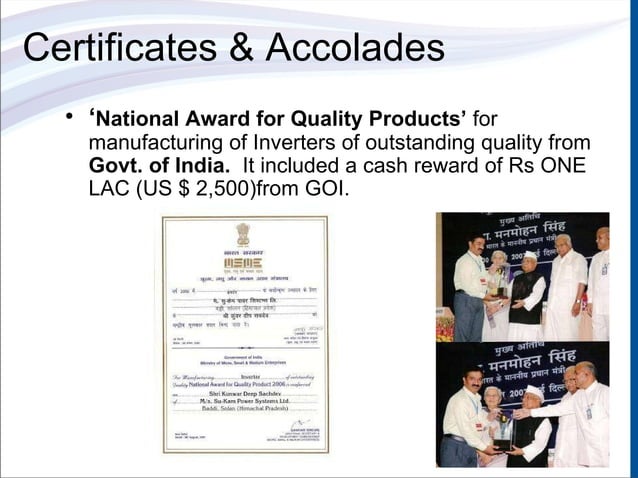
This one carries the State’s name. Ministry of MSME. Outstanding manufacturing of inverters. Issued with my name on the certificate as founder alongside Su-Kam, Baddi. Cash component. Ceremony in the era of Prime Minister Dr. Manmohan Singh.
Quality awards have checklists. Documentation. Line discipline. Defect data. I did not outsource the seriousness of that application. Getting the National Award meant our plant had to meet criteria that most of the unorganised inverter trade never even attempted. That is how a brand gets built: not by claiming quality — by surviving a government form.
Slide 6 — Sectoral Export Award (Ministry of Commerce)
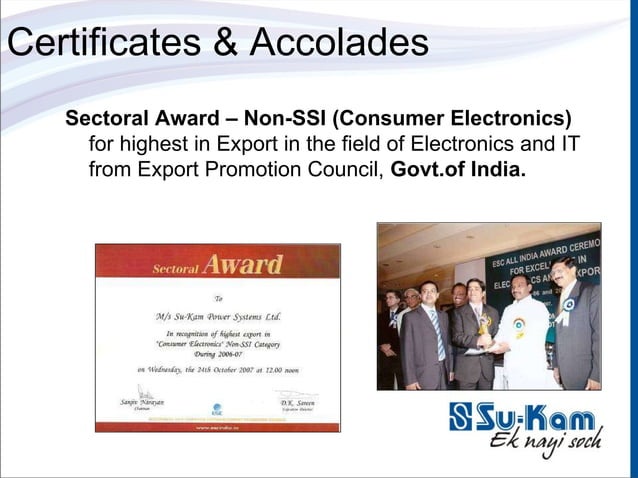
Distribution was my forte — inside India through dealers, and outside India through export relationships I built personally. The Sectoral Award for highest exports in Consumer Electronics (Non-SSI), from the Electronics & Computer Software Export Promotion Council under the Ministry of Commerce, was the government saying the numbers matched.
Export awards demand shipping proofs, category definitions, year-on-year data. Forms again. Attachments again. My involvement again. A power-backup company topping a consumer-electronics export category was not the story people expected from our industry. It became our brand story because the criteria forced us to actually ship — Africa, Middle East, South Asia — not just talk about “global presence.”
Slide 7 — Business Superbrand — Trophy from L. K. Advani
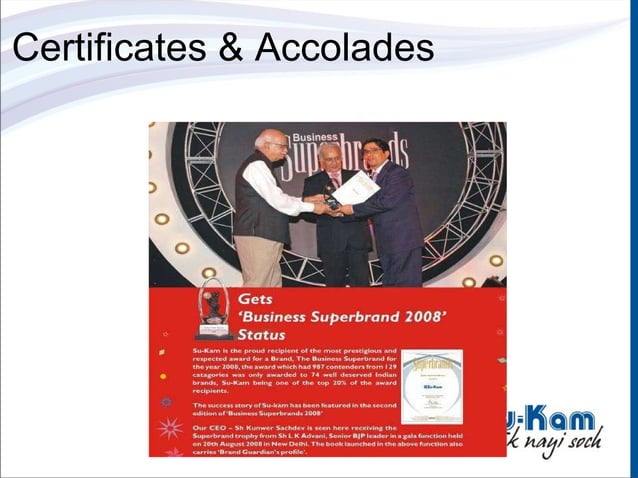
Superbrand is brand language — trust, recall, category leadership. For Su-Kam it meant the market was finally treating a power-backup company like a serious business brand. The trophy came into my hands from Sh. L. K. Advani at a New Delhi function. The book called the founder a Brand Guardian. I took that to mean the brand belonged to every dealer and service engineer who kept a promise at ten at night — not to a logo file in Gurgaon.
Brand awards still have criteria. Case studies. Consumer evidence. Proof packs. We prepared them. Early press such as Business Today’s “Dark horse” profile already framed Su-Kam as a technology-and-brand bet in an industry of commodity boxes.
Slide 8 — Marico Innovation Award — Business Model, Not Just Product
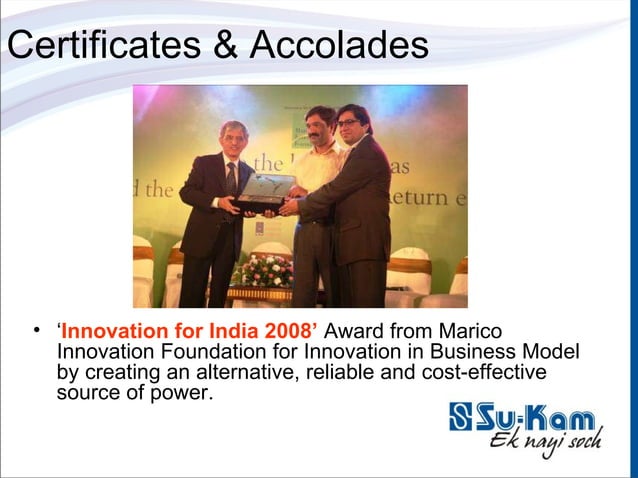
Marico’s Innovation for India Awards recognised Su-Kam for organising a fragmented power-backup market — reliable, cost-effective, energy-efficient alternatives to the old generator-and-junk trade. That is distribution and technology together: product invention plus a dealer-and-service architecture that could scale.
The Foundation’s own winners page still lists Su-Kam for 2008: Marico Innovation Foundation — Winners 2008. That external page is the media record. The application behind it was another stack of proofs — and again, my personal involvement in making sure the story we told the jury matched the work on the ground. Full founder chapter: Marico Was the Toughest Award We Ever Won.
Slide 9 — Whyte & Mackay Stage — Brand Evenings Beyond the Factory
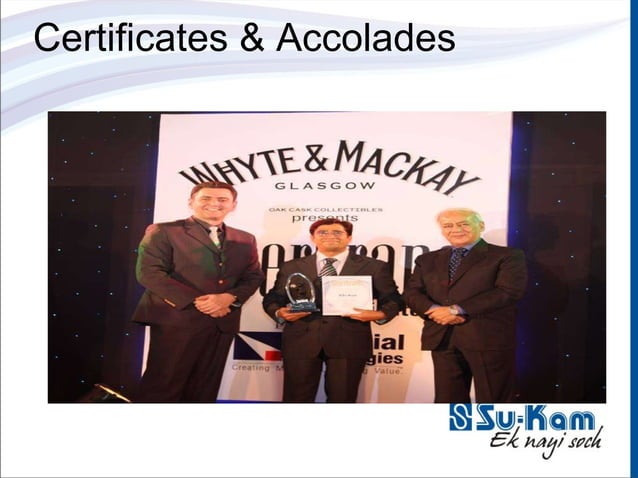
Not every slide is a ministry seal. Some are brand evenings — rooms where Indian builders were treated as peers. This photograph is one of those nights: certificate, trophy, stage lights. For Su-Kam it mattered because a power-backup founder standing in that kind of hall told dealers and customers the same thing: we were not a temporary local brand. We were building something that belonged in larger rooms.
Slide 10 — ISA Technovation — Viswanathan Anand, Bangalore
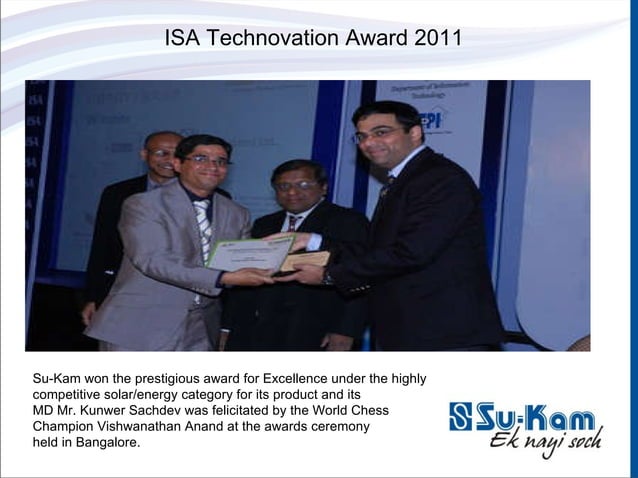
This is the slide that still surprises people. The India Semiconductor Association’s Technovation Award in Energy/Solar for Su-Kam’s Solar PCU — trophy placed in my hands with Viswanathan Anand felicitating winners. A semiconductor industry body. A power-backup-and-solar company. A category no one expected us to own.
Contemporaneous media: PC’s Semiconductors Blog listed Su-Kam’s Solar PCU as Energy/Solar winner; Pradeep Chakraborty’s note recorded Anand at the evening. I have written the full founder account — receiving the award, then speaking to a hall of mostly foreign semiconductor companies — here: ISA Technovation founder blog.
Slide 11 — Entrepreneur of the Year
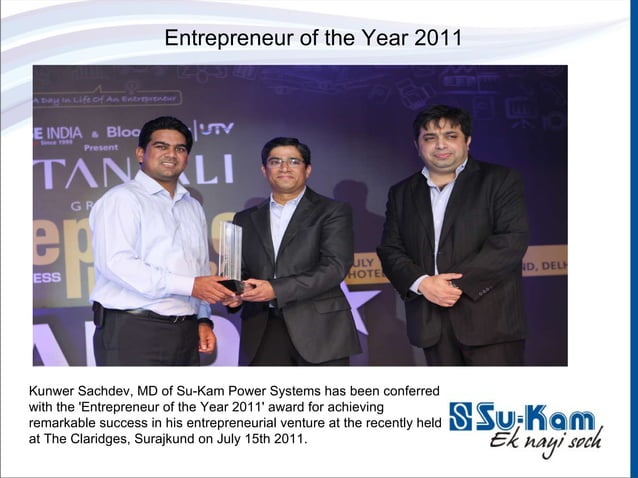
Company awards build the brand. Entrepreneur awards name the person who made the bets. I accepted them for Su-Kam’s sake — then pointed the room back to the engineers, dealers and export desks who had fulfilled the criteria with me. The nominations still needed forms. The forms still needed proof. Leadership is not a speech. It is a signature on documents you are willing to defend.
Slide 12 — Accolades Summary — The Brand on One Page
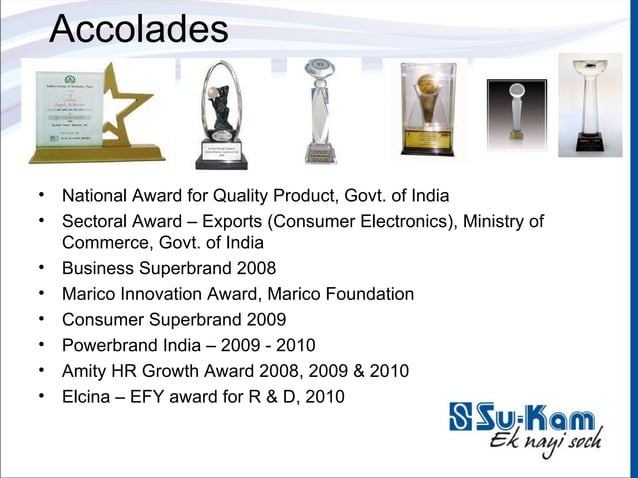
Read the list the way a jury reads it: National Award for Quality Product (Govt. of India). Sectoral Export Award (Ministry of Commerce). Business Superbrand 2008. Marico Innovation Award. Consumer Superbrand 2009. Powerbrand India 2009–10. Amity HR Growth Award 2008–10. ELCINA-EFY for R&D 2010. Add ISA Technovation and Entrepreneur of the Year from the earlier slides.
That is not a random cabinet. That is a map of criteria we chose to fulfil: quality systems, export numbers, brand trust, innovation in business model, R&D depth, solar technology, people culture. Each one helped build Su-Kam as a technology-and-distribution brand because winning forced us to become the company the form described.
What I Want the World to Understand
People remember trophies. I remember the forms. I remember attaching proofs of work — factory data, export shipments, patent lists, dealer networks, solar PCU engineering — because that was how a power-backup company earned the right to stand next to electronics majors and semiconductor juries. Nobody imagined that category for us at the start. We imagined it first. Then we filled the paperwork. Then the awards followed.
Under my leadership, Su-Kam’s brand was not built by claiming technology and distribution. It was built by surviving every criterion those awards put in writing.
FAQ
What awards did Su-Kam win under Kunwer Sachdev?
Major honours include the National Award for Quality Products (Govt. of India), Sectoral Export Award (Ministry of Commerce), Business Superbrand 2008, Marico Innovation for India 2008, ELCINA-EFY R&D Award, ISA Technovation 2011, Entrepreneur of the Year 2011, plus Superbrand/Powerbrand and Amity HR awards.
How did awards help build the Su-Kam brand?
Each award had published criteria. Winning meant fulfilling quality, export, R&D, innovation or brand standards — and documenting proofs. That process, under Kunwer Sachdev’s leadership, forced Su-Kam to operate as a technology and distribution brand, not only a power-backup trader.
Did Kunwer Sachdev personally handle award applications?
Yes. He was personally involved in filling nomination forms and attaching proofs of factory, export, patent and field work — treating applications as audits of the company’s real capabilities.
Where is the full Su-Kam awards chronicle online?
The complete 1993–2019 record is on KunwerSachdev.com. The original 12-slide deck is on SlideShare. This SolarManOfIndia post walks each slide in the founder’s voice with media citations.
External Media & Primary Sources
- KunwerSachdev.com — Su-Kam Awards and Recognition Under Kunwer Sachdev (full 1993–2019 chronicle)
- InverterManOfIndia — Awards and Recognition of Kunwer Sachdev
- Wikipedia — Kunwer Sachdev
- Su-vastika — Kunwer Sachdev mentor bio (awards)
- SlideShare — Awards and recognition achieved by Su-Kam Power Systems Ltd (source deck)
- Marico Innovation Foundation — Winners 2008 (Su-Kam)
- PC’s Semiconductors Blog — ISA Technovation Awards 2011 (Su-Kam Solar PCU)
- Pradeep Chakraborty — ISA Technovation awards 2011: Anand, the top draw
- IT Voice — Su-Kam Receives “Asia’s Most Promising Brand” Award
- APN News — Su-Kam receives Brand Excellence in Business Innovation Award
- SME Times — Kunwer Sachdev among Hurun’s Most Respected Entrepreneurs 2017
- Economic Times — A powerful idea was his calling
- Business Today — Dark horse (Kunwer Sachdev / Su-Kam)
Related
- Marico Innovation 2008 — toughest award founder account
- Certifications & awards hub — CE, UL, ISO + full illustrated ledger
- KunwerSachdev.com — full Su-Kam awards chronicle
- InverterManOfIndia — Awards and Recognition essay
- ISA Technovation — full founder account
- Recognition & Awards
- Bolivia Ambassador visit
- All blogs