I Flew to Afghanistan Twice. We Powered Telecom Across 17 Provinces.
US Army era. Afghan government mandate. Solar on telecom towers — under my leadership as CEO & MD.
By Kunwer Sachdev · CEO & Managing Director, Su-Kam (at the time) · Founder 1988–2018 · Published September 27, 2026 · Historical era: ~2012–2014
Already told on KunwerSachdev.com — read the founder essays there, then the US Army–era / two-visits detail here: 10 Stories From the Field (Afghanistan) · Solar installation projects · Made Solar Affordable.
Trade / company sources: Electronics Maker (Wayback) · Su-Kam blog — Afghanistan Telecom (Wayback) · Electronics For You.
Afghanistan was the hardest place I ever carried the Su-Kam brand — and I went there personally, twice.
US Army Era — How the Contract Sat
This was the time of the US Army in Afghanistan. Under my leadership as CEO and Managing Director of Su-Kam, we won a major solar mandate for communications infrastructure. I worked with the Afghanistan government on the ground — a government apparatus that, at that time, was mainly shaped and controlled through the US military presence. That is the political and security frame in which the contract lived. We also worked with the US Army on certain other projects; those cannot be explained here. What I will put on the public record is the telecom solar work that trade press, our company blog, and our Facebook archive already name.
Seventeen Provinces — Telecom on Sunlight
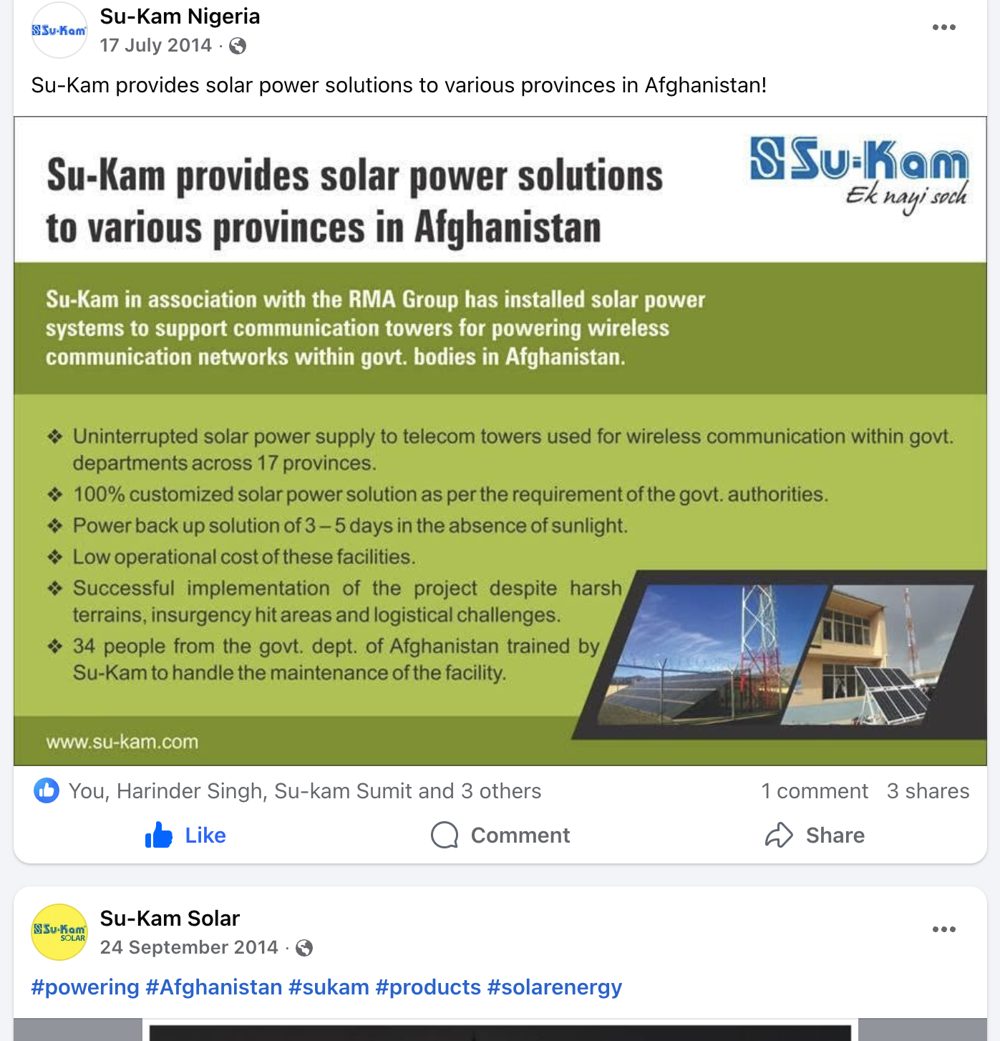
The July 2014 Facebook graphic — Su-Kam Nigeria / Solar community post — stated it clearly: Su-Kam in association with the RMA Group installed solar power systems to support communication towers for wireless networks within government bodies in Afghanistan. The card’s own bullets match what we delivered under my leadership as CEO & MD:
- Uninterrupted solar supply to telecom towers for wireless communication within govt. departments across 17 provinces
- 100% customised solar power solution as required by the authorities
- Power backup of 3–5 days in the absence of sunlight
- Low operational cost versus diesel-first sites
- Delivery despite harsh terrains, insurgency-hit areas, and logistical challenges
- 34 people from Afghan government departments trained by Su-Kam for maintenance
Our March 2012 company blog put the same spine in prose: towers powered entirely by solar, diesel only as standby. Most sites were engineered for multi-day backup where a single service visit could take weeks — hard roads toward places like Kandahar, Khost and Bamiyan in later phases. Impressed clients extended the footprint; the archive and library essay record a second push into further provinces.
Keeping a nation connected on sunlight, in one of the world’s most demanding operating environments, is not a job you take lightly. The July 2014 graphic carried that story to our community: solar across the provinces, RMA partnership, training included.
Solar PCUs — Indian Engineering on Afghan Roofs
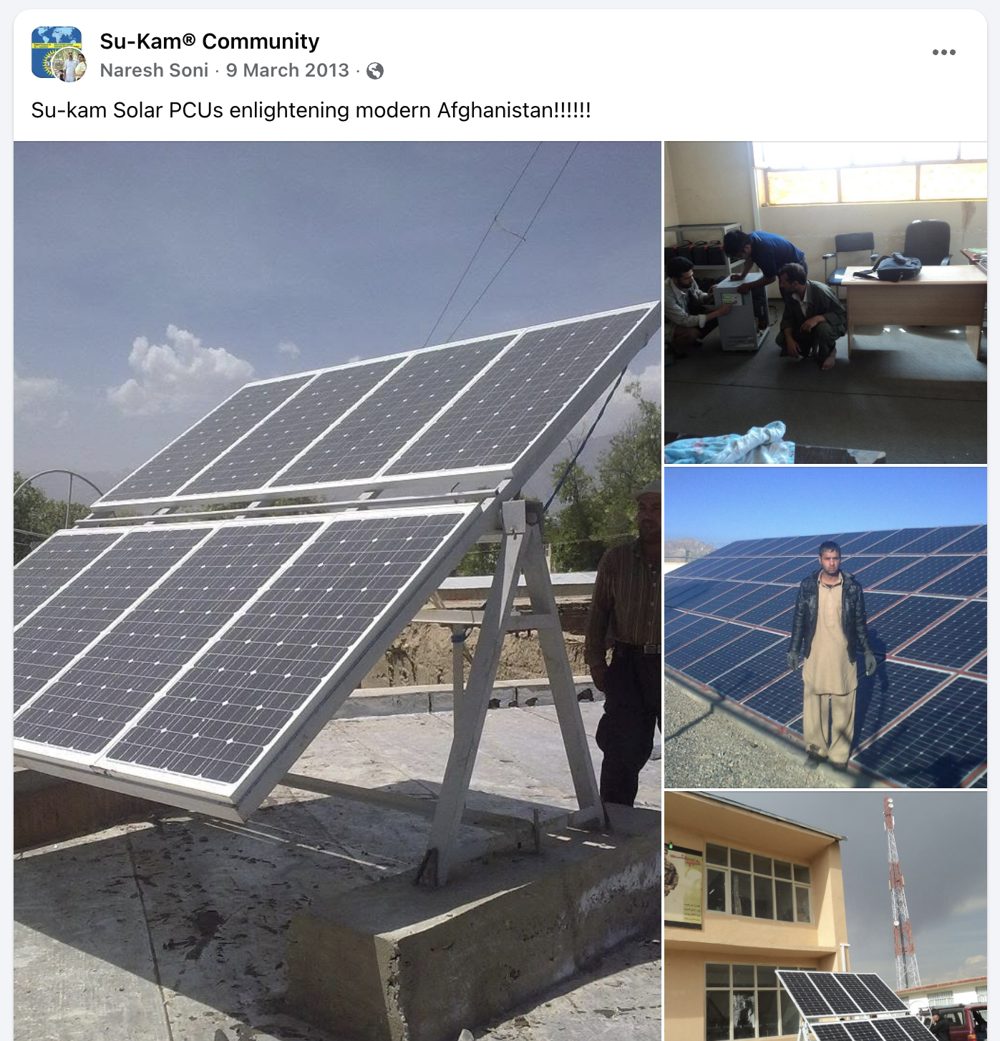
Parallel to the tower programme, Su-Kam Solar PCUs went onto rooftops and installations across Afghanistan. The March 2013 archive post — “Su-kam Solar PCUs enlightening modern Afghanistan!!!!!” — showed arrays and technicians at work. That product maturity is why a government telecom mandate in wartime geography was even thinkable for an Indian power-electronics company.
Why I Went Twice
Family opposition to those trips was fierce. Security could turn in an afternoon. I still went — twice — because government energy and communications crises do not get solved by brochure PDFs from Gurgaon. As CEO & MD I needed to sit with the people who signed and the people who would run the towers. That is how Su-Kam became trusted as a turnkey solar provider in that country for this class of work.
Remember the wider timing too. This was before the Modi government’s later national solar focus in India dominated the headlines. Under my leadership we were already pushing solar hard — state governments at home, and the hardest international terrains abroad — developing products ourselves when electronics and batteries were still largely not an import free-for-all (panels were the main import). Afghanistan proved that stack could travel.
What I Want on Record
Kunwer Sachdev — CEO & MD of Su-Kam. US Army era in Afghanistan. Contract won; Afghan government work; two personal visits. RMA partnership. Solar for telecom across 17 provinces; training for 34 government people; Solar PCUs on the ground. Other US Army–linked work left undescribed. Documented in Electronics Maker, the Su-Kam company blog, EFY, national wires that name Afghanistan among our overseas solar projects, Facebook archive, and KunwerSachdev.com.
Verified Sources
- Electronics Maker (Wayback) — Su-Kam sustainable power solutions across Afghan provinces
- Su-Kam company blog (Wayback, 10 Mar 2012) — Augmenting Afghanistan Telecom (17 provinces, solar + diesel standby)
- Electronics For You — Kunwer Sachdev on global off-grid kits (Afghanistan telecom towers named)
- Economic Times (PTI) — Su-Kam overseas solar projects including Afghanistan (pass-through)
- KunwerSachdev.com — Su-Kam Solar Projects: 10 Stories From the Field (Afghanistan 17 provinces / RMA / training)
- KunwerSachdev.com — Solar installation projects (Afghanistan Solar PCUs)
- KunwerSachdev.com — Made Solar Affordable for India (Afghanistan PCUs named)
- Facebook Archive — Solar PCUs + 17 provinces cards
- Library archive — Su-Kam Augmenting Afghanistan Telecom
FAQ
What did Su-Kam do in Afghanistan?
Under Kunwer Sachdev as CEO & MD, Su-Kam — working with the RMA Group — installed solar systems powering telecom towers and wireless communication networks across 17 of Afghanistan’s 34 provinces, and trained 34 people from Afghan government departments. Facebook archive and the old Su-Kam company blog also document Solar PCUs and rooftop arrays in Afghanistan.
Did Kunwer Sachdev go to Afghanistan?
Yes. He travelled to Afghanistan personally twice to work with the Afghan government on this mandate — at a time when the US Army was present and the government apparatus was heavily influenced by that presence. He treats it as among the hardest markets Su-Kam ever entered.
Was this connected to the US Army period?
Yes. The contract sat in the era of US Army presence in Afghanistan. Su-Kam also worked with the US Army on certain other projects that Kunwer Sachdev chooses not to detail publicly. The public, citable spine is the telecom solar work with government / RMA across 17 provinces.
Where is this documented?
Electronics Maker (trade press, durable via Wayback); Su-Kam’s March 2012 company blog on augmenting Afghanistan telecom (Wayback); Electronics For You quoting Kunwer on powering telecom towers in Afghanistan; Economic Times/Business Standard wires that list Afghanistan among Su-Kam’s overseas solar projects; Facebook archive posts (March 2013 PCUs; July 2014 17 provinces); KunwerSachdev.com field essays.
Related
- KunwerSachdev.com — field essay (17 provinces / RMA / training): Su-Kam Solar Projects: 10 Stories From the Field
- KunwerSachdev.com — solar projects (Afghanistan PCUs): The Solar Projects — installations that made us proud
- KunwerSachdev.com — affordability essay: How Kunwer Sachdev Made Solar Affordable for India
- India telecom towers — Tata first, then Reliance
- Gabon — street lights & 40,000 homes
- Malawi — wind–solar hybrid · Natsons · GITEX
- Assam Rifles — Moreh 100 kW
- Library — Afghanistan telecom archive
- Facebook archive
- All solar blogs